Birds and Blooms

A Celebration of Our Natural World through Stories and Photography by Jim Flowers

  • Home
  • About

“Fall Migration” a time for discovery!

Posted by Jim Flowers on August 23, 2014
Posted in: Birding, Birds. Tagged: Carroll County Maryland, fall migration, Hanover Watershed, Maryland, Pennsylvania, Schoolhouse Road. 6 Comments

Fall Migration Title

type leafEach of our wonderful seasons can bring a variety of birding and avian photography opportunities, but the shorter days with the slightest hint of a chill in the air, will signal the return south for many species and the chance to observe and photograph not only our local resident feathered friends, but the many others that only pass through our area on their journey from their summer breeding grounds to their wintering habitats. This has to be my favorite time of year to get out and explore a few of my favorite nearby birding locations on almost a daily basis to see who might be passing through and/or taking a rest during their arduous trip south.

I concentrate my efforts with dedication and zeal during my exploration of my local haunts; spending hours looking and listening for the slightest movement or sound from the woodlands and grasslands near my home.  The following will be a small sampling of my photographic efforts during the past fall seasons.

You never really know what species of passerine (perching birds) you might find during the fall migration and this period is truly “a time for discovery” or a renewal of your discoveries with avian species you may have seen passing through during the spring months.  Searching for individual species during the spring and summer months is usually more specific to their habitat and breeding locations,  whereas the sightings in the fall are normally less habitat restrictive and more based on their chosen route of travel.
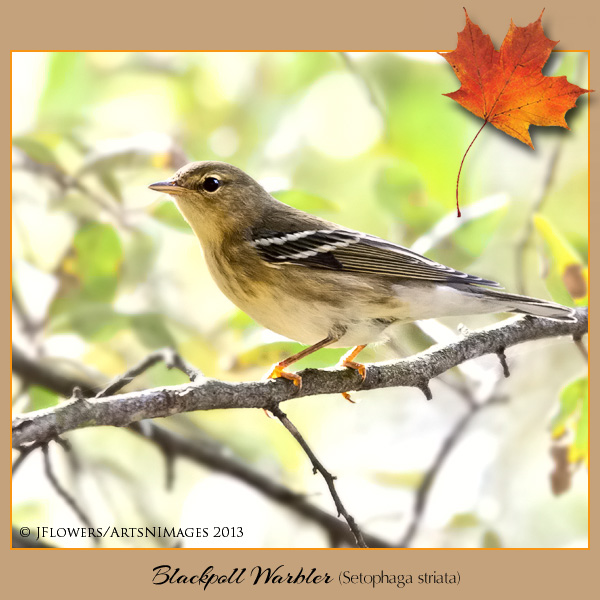
blackpoll warbler

Above is a migrant Blackpoll warbler I found resting in my local watershed.  He was quite the beauty!

type leaf RWeather can play an important role during both the fall and spring migration as we look for a phenomenon called “fallout.”  Inclement weather, usually including strong winds and rain,  slows the migrating birds down causing them to rapidly use up their stored energy reserves.  Thousands of extremely tired migrants are forced to seek shelter, food and a period of rest thus presenting an ideal time for observation and photography by “considerate” birding enthusiasts and avian photographers.

I cannot stress enough the importance of “consideration” to the welfare of these species that should be given by the birding community and avian photographers;  and the public in general!!   Harassing these birds by any means during a“fallout” is just as detrimental to the bird as the same bad behavior as trying to get a “closer look” or a better picture by invading their space or using any sounds, vocal or recorded, while they are establishing their territories, nesting and raising their young.  There are plenty of times when these practices can be safe as long as they are kept to a minimum.

Patience is a “virtue”, and a careful dedicated study of a chosen area can pay off in royal dividends when it comes to getting that close look or excellent photograph of a bird.

magnolia warbler

A very common fall visitor to my watershed and other favorite nearby locations; and normally in abundant numbers, is the Magnolia Warbler. (pictured above)

type leafI am more into quality than quantity when it comes to my bird observations and photography!  I’ve never been one to go out and see just how many species I can add to a list in a single outing, but I admire those who do and their efforts are helpful to all of us in the birding and avian photography community.

I guess my “list” would consist of my photographs for the day.   I do keep notes on occasion,  and submit “special” findings to e-bird and sometimes the local birding list-serves..  I by far more enjoy quietly observing and photographically documenting the behavior of a given species for an extended period of time.

My method of “discovery”,  and hopefully successful observation and photography of a species will include finding a “birdy” location along my way and quietly sitting and watching the landscape for activity; and I may sit for hours at a single location “waiting and watching” while taking advantage of any photographic opportunities that present themselves.   I might be using my vehicle as a “hide” on a seldom traveled or an “off the beaten path” roadway or hiking through the woodlands, grasslands or coastal marshes.

I have always been somewhat a loner and rarely participate as a member of large birding or photography groups.  I prefer to observe and photograph nature in quiet solitude with a minimum of distractions.  I work better that way and I have more time to devote to an individual member of a species and capture its behavior and every day activities.

I do have a very special birding friend, and that is my Chocolate Labrador Retriever, Tucker who enjoys our outings as much as his dad!  He likes to sit in the rear seat of my vehicle and watch the birds as I photograph them from my window.  I do have a few human friends who accompany me on occasion.

blue-winged warbler

An uncommon visitor to my watershed,  this Blue-winged warbler (pictured above) was a very surprising find and nestled in a lovely setting for a photograph. However,  I have seen a breeding pair not far away in another favorite area along the Kowomu Trail in northern Carroll County Maryland.  I have noticed them at that location for several years now.  I also had one singing along a gravel road on the border of the Codorus State Park in York County Pennsylvania during the spring.

type leaf RAs I mentioned above,  I have “select” areas where I heavily concentrate my attention and effort during the fall migration.  Most are very close to my home while several others are located in neighboring states.  The “hot-spots” near my home are located within both the states of Pennsylvania and Maryland and I luckily reside less than one-half mile just above the noted Mason-Dixon Line separating the two.

The area I frequent the most is the Hanover Watershed CWMA and the Hanover Watershed (joined together) in Carroll County Maryland and York County Pennsylvania.  It’s an easy 5 minute drive and allows me daily visits with more time to observe and photograph and less time to travel.  “Its back-yard birding at it’s best!”

Canada Warbler

The Hanover Watershed CWMA has been full of surprises this past fall and the above Canada Warbler was a first for me at this location.  I normally find this species deep within the rhododendrons and along the small clear streams of the Michaux State Forest,  just west of Gettysburg Pennsylvania and another one of my favorite fall locations.

The Hanover Watershed CWMA (Maryland) and the Hanover Watershed (Pennsylvania)

type leafLocated in portions of Carroll County Maryland and York County Pennsylvania,  the Hanover Watershed CWMA (Carroll County MD) and the Hanover Watershed (York County PA) provide a mixed forest rural oasis for bird life along the Mason Dixon Line!

Travel through the watershed is by less traveled gravel roads with plenty of room to pull of to the side and park to hike the roads themselves for birding and photography opportunities.

ovenbird

A “breeding” resident and a consistent songster with his “Teacher – Teacher – Teacher” tune,  the Ovenbird is quite abundant within the Watershed and most of my local haunts!

type leaf RThe Hanover Watershed CWMA  (Wildlife Management Area) on the Maryland side,  is a “by permit only” hunting area which I believe tends to see very little pressure from sportsmen,  at least far as long as I have been frequenting the area.  I can’t recall ever hearing a shot fired.  I would guess that the location is mostly bow hunting orientated!

The primary and most productive access to both the CWMA and Hanover Watershed proper is by Kridler’s Schoolhouse Road,  which can be reached directly off of E. Deep Run Road,  west of MD Route 30 or from  MD Route 30 via Yingling Road just before the Pennsylvania state line.

nashville warbler

A very exciting find for me during the fall migration of 2012, was this Nashville Warbler searching for food in a brushy area, just after crossing the Pennsylvania state line along Kridler’s Schoolhouse Road.
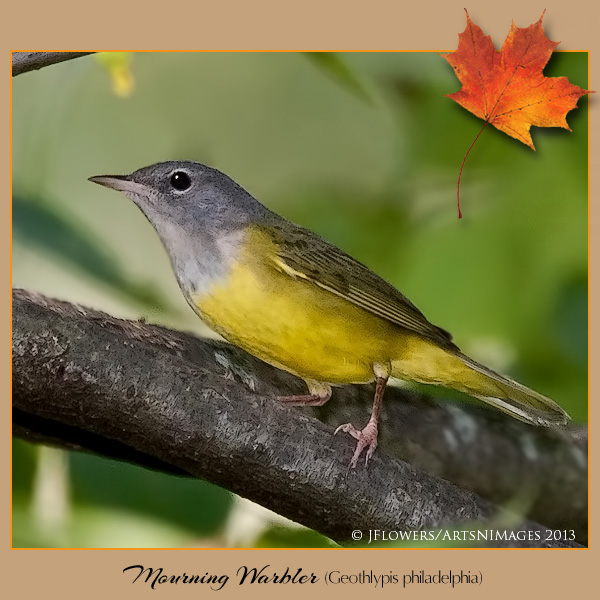
mourning warbler

Ironically, I found this Mourning Warbler less than 10 feet from the same spot this year.  (2013)   Another exciting find that “made my day”!   It’s amazing how closely these two species resemble each other except for the gray neck and throat of the Mourning..

type leafTraveling from E. Deep Run Road along Kridler’s Schoolhouse Road you will pass through a small rural residential area and then down a hill through woodlands to the junction of Yingling Road!

Turning left and continuing on Kridler’s Schoolhouse Road, you will pass a willow grove on your left (private property) that is a birding “hot-spot” and very productive throughout the seasons.

I have photographed over 30+ species at this location.  I made it a point to introduced myself to the landowners and over the past years have gained their trust.  Birding and photography can be excellent from the road in front of their property.

The open areas are loaded with Cardinal flowers (Lobelia cardinalis) and Spotted Jewelweed (Impatiens capensis) during the mid to late summer months and can draw hummingbirds by the dozens.

kentucky warbler

Another exciting surprise during the fall migration of 2012 was this rather inquisitive Kentucky Warbler who paid me a visit along Kridler’s Schoolhouse Road. This was first for me as far as photographing this species,  although I hear their songs on a regular basis during the spring.

type leaf RFrom the “willow grove” and continuing north on Kridler’s Schoolhouse Road,  your journey will take you through mixed forests as you follow the tiny headwaters of South Branch Conewago Creek and some of the best birding and photography opportunities within the CWMA.

You will pass the junction of Garrett road and continue across the Pennsylvania state line and enter the Hanover Watershed which is a joint venture with the borough of Hanover and the P.H. Gladtfelter Paper Company located in Spring Grove Pennsylvania.
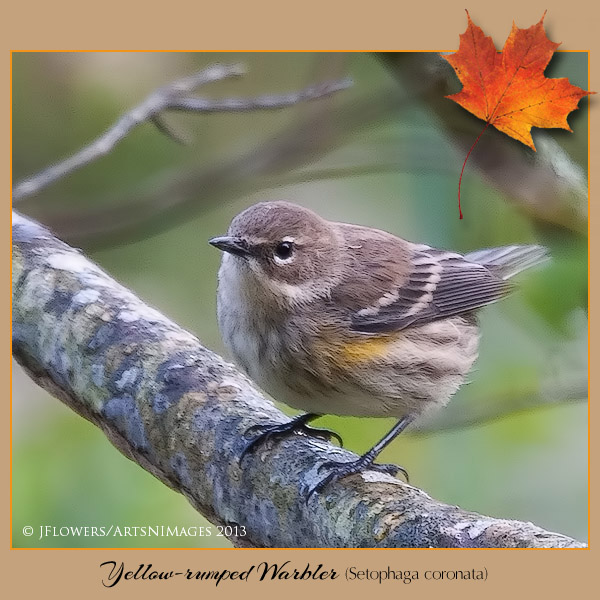
yellow-rumped

During the fall migration of 2012, I found this Yellow-rumped Warbler sitting on a limb of a fallen tree just north of the Garrett Road intersection. He was more than willing to pose for a few pictures.

type leafAfter crossing a small bridge over the South Branch Conewago Creek and continuing up the hill thorough the woodlands,  Kridler’s Schoolhouse Road will come to an end at it’s junction with Bankard Road. Be sure to be very observant along Kridler’s Schoolhouse Road before crossing the creek for fall raptors, especially the Red-shouldered Hawk (Buteo lineatus)  and Red-tailed Hawk (Buteo jamaicensis) whom are normally present!

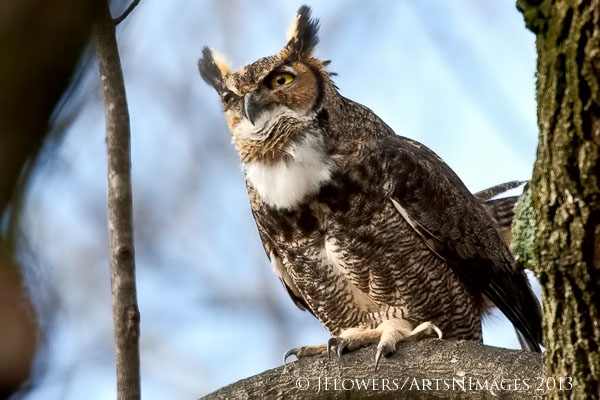
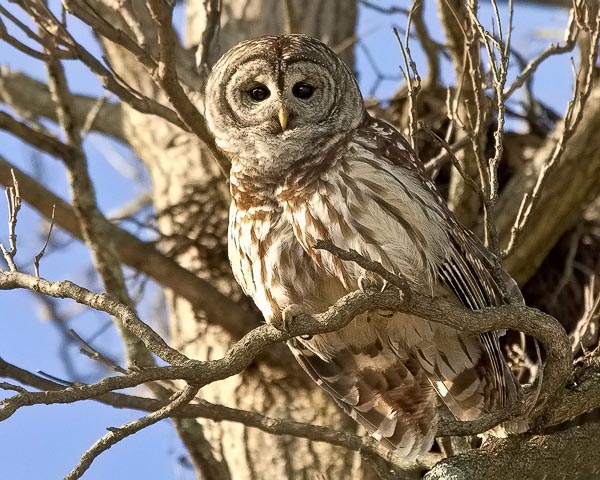
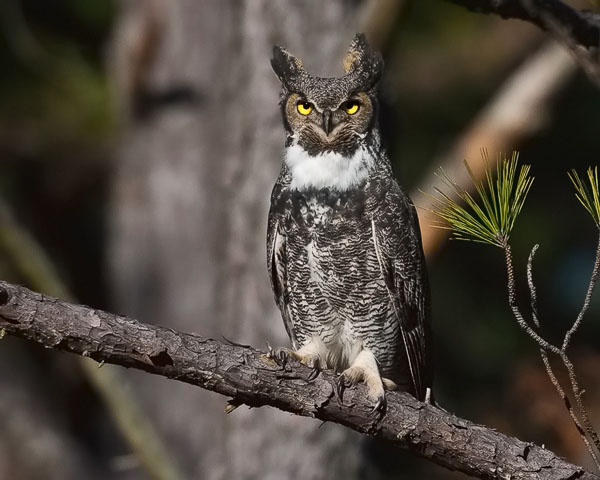
There are several pairs, if not more of Red-shoulders and Red-tails who breed within and call the watershed home on a yearly basis. Both the Great Horned Owl (Bubo virginianus) and the Barred Owl (Strix varia) reside within the watersheds forests and the late fall is a great time to listen for their “hoots” of courtship.  If you’re lucky, you might even get to observe and/or photograph one!

Black-throated blue warbler - male

One of my favorites, and most contrasting in colors, is the Black-throated Blue Warbler (pictured above) which I also normally find among the Laurel thickets within the mountainous terrain of the Michaux State Forest west of Gettysburg.   Historically, this was a “first ever” find for me in the Hanover Watershed CWMA and took place this past fall (2013).

Black-throated blue warbler - female

And then to put the “icing on the cake”,  I was able to, on the same day, add the Black-throated Blue Mrs. (female) too!!!!!!!! (pictured above)

type leaf RNot directly related to the fall migration, but taking a left onto Bankard Road from Kridler’s Schoolhouse Road, and proceeding up the hill, will take you to a lovely cut area, (to your right) loaded with new pine growth and is one of the best locations in the Hanover Watershed for finding breeding Prairie Warblers and Indigo Buntings.

I also found a “wayward” Golden-winged Warbler at this location several years back! The fall and winter months bring sparrows such as the White-throated, Field and Song.   Eastern Blue birds make an appearance on occasion as well as patrolling raptors!

ruby-crowned kinglet

The fall months also bring the wintering birds to the watershed and one of my favorites is the Ruby-crowned Kinglet. This is just one of about twenty that was occupying this tree and he went “vogue” for a few photographs..

type leafAlthough the most popular with me,  Kridler’s Schoolhouse Road is not the only productive pathway for birding and avian photography in the Hanover Watershed Pennsylvania sections.  Another is Deer Road which can be accessed off of PA 94 (Baltimore Pike) or Impounding Dam Road. (traveling south-east from Old Westminster Road)  Deer Road is a narrow gravel affair and hardly traveled by motor vehicles except perhaps for the two residences just west of the Baltimore Pike.

I can sit for hours and never see another vehicle west of the two houses. The road is heavily forested except for a logged section to the north and beyond an area of thick tall pines which is the primary tree of this forested area. There is however dense vegetation along the forest floor and very popular with the always vocal Ovenbird who seems to be forever present during the breeding season.
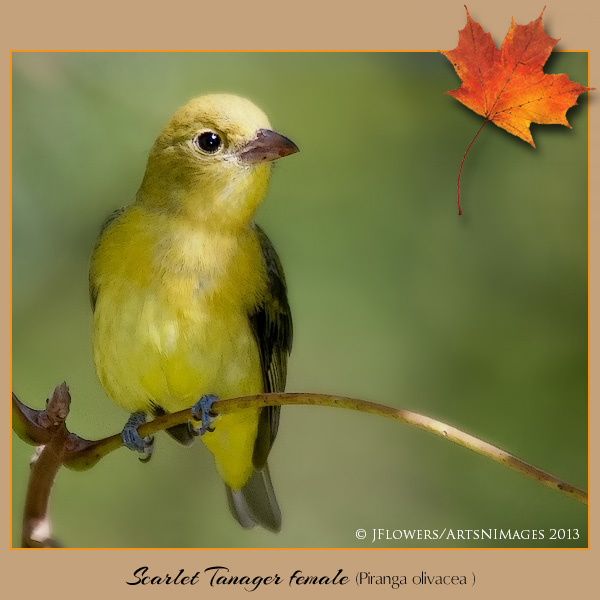
scarlet tanager female

We all are overwhelmed by,  and adore the brilliant cool “reds” of the Scarlet Tanager,  but hardly pay homage to the female of the species.  I found this young lady perched on a low bush below the pine canopy along Deer Road.  She was quite the camera ham and seemed to enjoy my company,  even with the flash firing away.  For a good exposure and color depth, a flash is a necessity along Deer Road!!

type leaf RFor those birding with a good spotting scope or photographing with a long telephoto lens,  a few of the standing dead trees in the logged section provide homes for the resident Red-headed and Red-bellied Woodpeckers. Other Woodpecker species within the watershed include the Hairy, Downy and the Pileated.

The rest of the roads that provide access to and travel through the Watershed are productive as well but care must be exercised in pulling off to the side and parking as most are heavily traveled. Also a suitable road shoulder to support a motor vehicle is at a minimum!
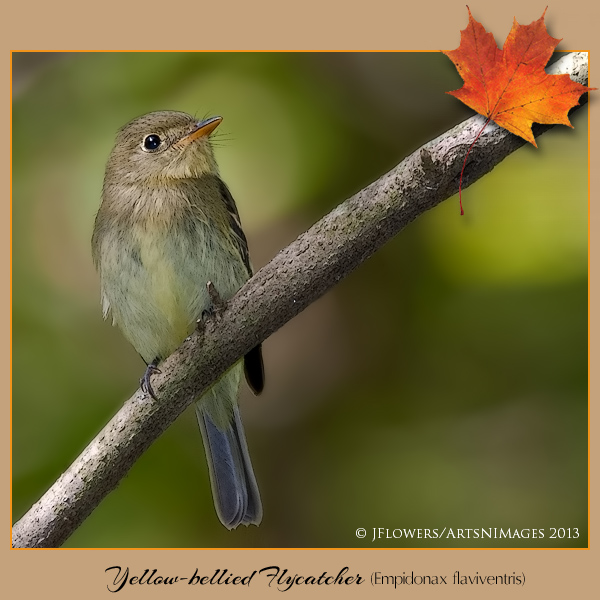
Yellow-belliedFlycatcher1304

One of,  if not the most exciting find of the 2013 fall migration,  was the Yellow-bellied Flycatcher (pictured above);  and only just a few minutes from home at that!   I have been searching for this species for the past five years and wanted so badly to be able to includes its portrait to my past blog article, “The Flycatchers” which documented this interesting family of birds.  “Wow” was this bird a surprise!  The Yellow-bellied Flycatcher breeds much farther north of this area and migrating birds present the only opportunities for one’s observation and photography within my region of the United States. 

Codorus State Park, Morningstar Road (Pennsylvania)

type leafDeparting the Hanover Watershed and traveling about ten minutes east in southern York County Pennsylvania, Codorus State Park affords numerous opportunities for some excellent birding and photography throughout the seasons. I like to use my vehicle as a “hide” and there is a small gravel road that traces the northern border of the park and provides me with wonderful chances to get that “great photo” of numerous species. cerulean warbler

“Now you see me and now you don’t!”  This Cerulean Warbler (pictured above) was an inspiring find along Morningstar Road this fall, however he only gave me a short opportunity for a single image!  I took the picture and then checked the histogram on the camera LCD for exposure and looked back up and he was gone!  So what you see is what you get!!!   I heard their familiar song during the spring but hadn’t laid eyes on the bird.  Perhaps he is breeding at this location.  

type leaf RTraveling south from the Hanover borough, and east along PA Route 216, Morningstar Road will be your third left after crossing the third bridge over the arms of Lake Marburg.  This little road travels east for about a mile or so and ends at its junction with Skyview Drive.   It follows a tiny stream on your left with a mixture of dense vegetation and hardwood forest on both sides for about three-quarters of its length before opening up into pastures and farm land. Black-throatedGreenWarbler1316
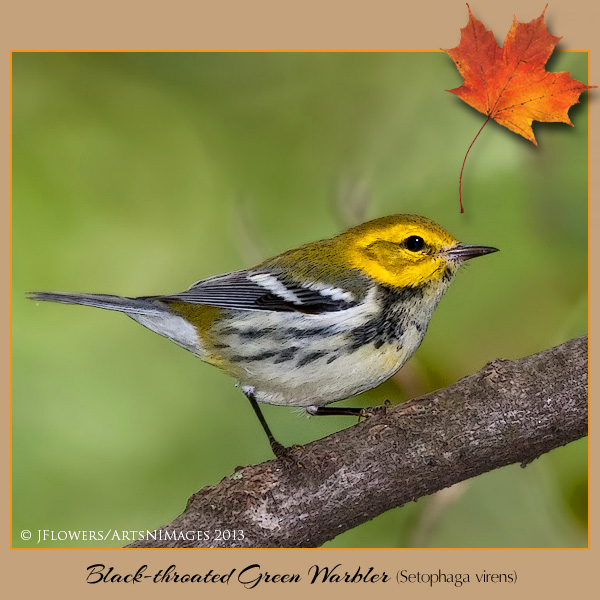
The most abundant warbler this past fall (2013) throughout my local haunts was the Black-throated Green (pictured above) and these little rascals where everywhere. I must have photographed over 40 individual members of this species during a six-week period. I can’t recall ever encountering so many of these little guys! The Magnolia usually takes the prize in the “abundance” category…

type leafNavigating Morningstar Road to the east,  the best birding and photography opportunities will be to your left along the stream.  There is a single residence about an eighth-mile on your right that sits back in the woods followed by a farm also to your right near the end of the road.

Most of the right side of the road consists of a steep dirt bank,  whereas the left side with the stream provides more open views and better light. During the late spring and summer,  the heavily wooded canopy can hamper much of the existing natural light and shooting with a flash is almost mandatory!

great crested flycatcher

The above Great Crested Flycatcher is one of several I observed and photographed this fall!  I found these to be a common species for this location over the past few years along with the Least Flycatcher and the Eastern Phoebe.  I’m still hoping for that long sought after Olive-sided Flycatcher which has eluded me to this day!

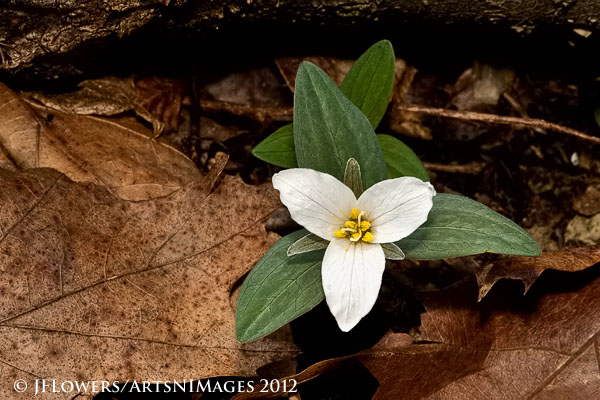
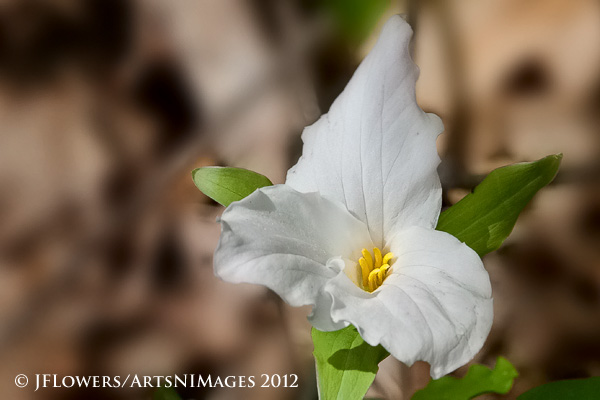
type leaf RMorningstar Road is a very special favorite of mine during the early spring for wildflowers. The Bloodroot (Sanguinaria) can be found in abundance along the steep dirt bank on the right side of the road. Bloodroot is one of my favorite early blooms along with the Snow Trillium. See “Bloodroot” War Paint and the Medicine Man, an earlier exploration of this lovely wild bloom…

For those exploring the area, and who enjoy narrow and less traveled gravel roads through woodlands,  returning to PA 216 and turning right (south) will take you a short distance to the intersection of Allison Mills Road.  Turn right on Allison Mills Road and follow it southeast to the junction of Blue Hill Road.

Proceed across Blue Hill Road at a very slight angle to the right and onto Lilly Springs Road, a narrow gravel affair traveling though a densely forested area filled with lovely sights and sounds of avian life..  Allison Mills Road, on its own merit, can be highly productive for a variety of species and follows a small stream.

The Kowomu Trail

Like the Hanover Watershed CWMA,  Carroll County Maryland hosts two more of my favorite local birding and avian photography hangouts.  Just 5.2 miles or so below the Mason Dixon Line;  or 8 miles north of the junction of MD 140 in Westminster MD and 14.5 miles south of US Route 15 in Gettysburg PA.   PA/MD 97 (Baltimore/Littlestown Pike) provides access to another narrow gravel road through the rural Maryland countryside and some wonderful birdy habitat.

Northern Parula

A juvenile Northern Parula warbler perches on a low limb next to the bridge over Big Pipe Creek.

type leafAt the junction with MD 97, Saw Mill Road W will travel for a short distance as a paved road down a hill, to a sharp left turn, and across a single-lane deck bridge across Big Pipe Creek and continue as a gravel lane called the Kowomu Trail….

I discovered the Kowomu Trail about 7 years back while looking for owls in my area and have been a regular visitor since!  The section just after crossing the bridge contains woodlands and a brushy stream-side meadow with plenty of cover and food sources for our avian friends. The habitat along the Kowomu Trail can be quite diverse from the previously mentioned to hardwood forests, farmland and a scattering of rural residences with a variety of cultivated flora.

Late summer and early fall brings many species to the Kowomu Trail in not only the migrating warblers but many of the species who actually breed in the area to light.
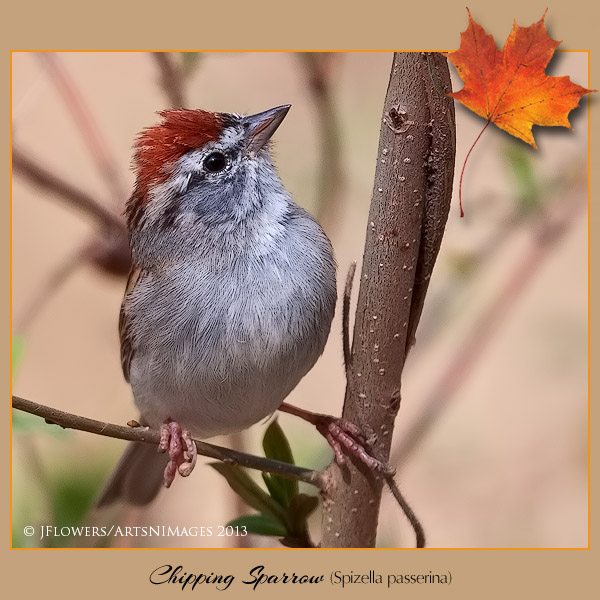
ChippingSparrow1309

A Chipping Sparrow “strikes a pose” near the equestrian trail entrance near the eastern end of the area.

type leaf RThe Sparrows begin to make a showing and are easier to find along the trail with the Chipping, Field and Song being the most common. Also in the area are the White-throated, White-crowned and an occasional Fox Sparrow.

I really need to spend more time on the sparrow species and a Face Book friend from Maryland; Bonnie Coats Ott has given me that inspiration over the past year. She goes by the nickname “Sparrow Bon” and has quite a collection of photographs and sightings.
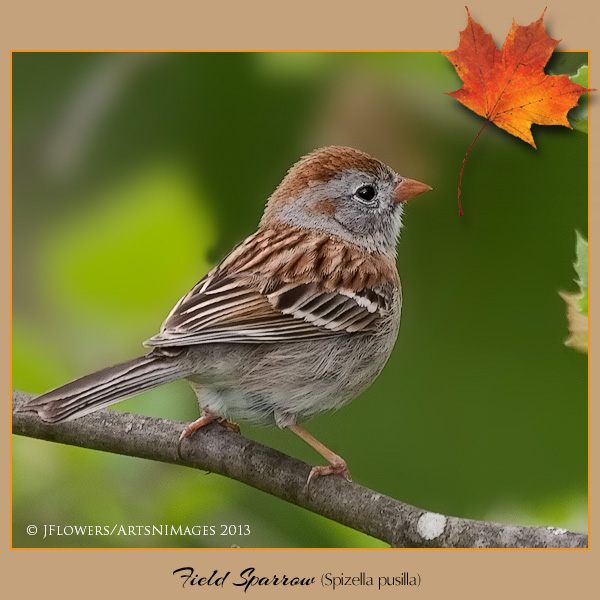
Field Sparrow

 Just one of many lovely Field Sparrows makes an appearance allowing an excellent photographic opportunity.

type leafOne of my favorite breeding species that seems to be abundant along the trail is the Veery.  With its haunting song and calls one can spend evenings enjoying the symphony of conversation between the different birds present in the area.  They tend to be quite shy and finding them for photographs is not an easy chore.  But once in a “Blue Moon” and with a little luck, you can find one in the open and get that special shot.

Veery1202

As one of my favorites of the Thrush family, I found this Veery perched in the open near the center parking area along the trail. It didn’t seem to mind my intrusion at all and allowed me numerous photographs and time to observe its beauty.

type leaf RBoth of our eastern species of the Oriole family can be found along the trail throughout their breeding and migration seasons, but it seems the Orchard is the most common.  I have heard the Baltimore on numerous occasions but have yet to actually see the bird, more-less photograph it.  But I will continue listening and trying.

Orchard Oriole

A lovely male Orchard Oriole makes an appearance in the same tree along the creek near the bridge as I was photographing the juvenile Northern Parula Warbler. His chest is washed in the vivid copper color of the spring breeding season.

type leafI cannot mention the Kowomu Trail without the recognition of my all time favorite discovery there; the Yellow-breasted Chat.  This species had been a nemesis for years and while photographing a White-eyed Vireo in a brushy area he made his initial appearance.

If you have never experienced their call or song, it seems to be a tune from the “wilds” of Africa or New Guinea.  It is truly interesting with a series of notes and whistles; sort of like that of the Brown Thrasher, less the whistle and far more intuitive and fun.  Classified as a warbler, the Chat is much larger.  I had read somewhere that this classification may change in the future if not already.  I have photographed this fella below over the past three years.

Yellow-breasted chat

A stunning male Yellow-breasted Chat shares his curiosity and beauty with his photographer friend along the Kowomu Trail in Carroll County, Maryland.

The Union Mills Wetland

type leaf RMy final local haunt to share is a mixture of a forest, brush and wetland habitat known as the Union Mills Wetland.  It is a very short distance north of the Kowomu Trail (Sawmill Road) and after passing through the small town of Union Mills.  It’s located off a gravel affair called Brown Road, to your left off MD Route 97 from Westminster.

The wetland is well-known to many locals in the birding community and holds a diverse amount of species although they are not always easy to observe.  I haven’t spent nearly as much time there as I would have liked to, but plan more visits this year and in the future.
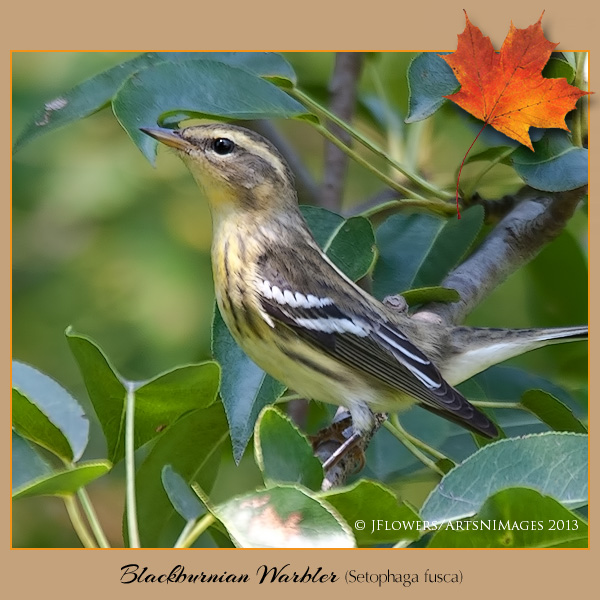
blackburnian warbler

A “Surprise” immature Blackburnian Warbler makes an appearance in some shrubbery along the road through the Union Mills Wetland. The Blackburnian in it’s breeding plumage remains a nemesis to me this day as hard as I have tried to find and photograph one in the open.

type leafThe area is a favorite of the local hunters who have permission to enter so plan your visits wisely.  Waterfowl can be prevalent, but the hunting is for the deer in the area.  I do not believe that waterfowl hunting is allowed; at least I have not witnessed any in the past which I am happy to report.

Visiting this area in the early spring can be an experience of “sight and sound” especially with the chorus of Spring peepers and Wood Frogs with the occasional Bull Frog singing bass.  Then you add in the tune of the Least Bittern who might make a visit along with other birds and you have a symphony of nature that will impress the most skeptical of listeners.
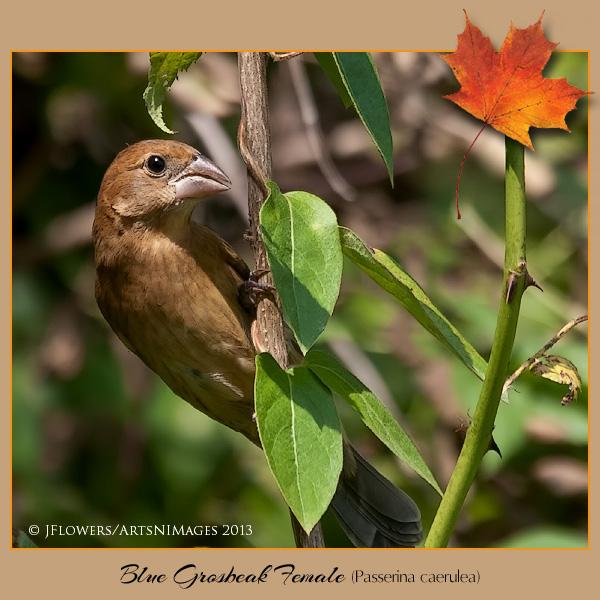
blue grosebeak female

Another “Surprise” visitor to the wetlands during the last fall migration was this female Blue Grosbeak. I have never observed either the male or female at this location, but then perhaps again, I need to spend more time there.

type leaf RThe wetland is also a great place for sparrows during the fall, winter and spring and I will highlight three species I didn’t image for the Kowomu Trail.  The king of the wetlands is the Swamp Sparrow (pictured below) and one of my all time favorites.  The grassy areas will hold the Savannah and the woodlands the White-throated Sparrow.  I am sure there are more that I didn’t see or hear at the time.

Swamp Sparrow

“What a Pose” this beautiful species offered his photographer. I must have photographed his frolic for 20 minutes before he finally disappeared into the reeds.
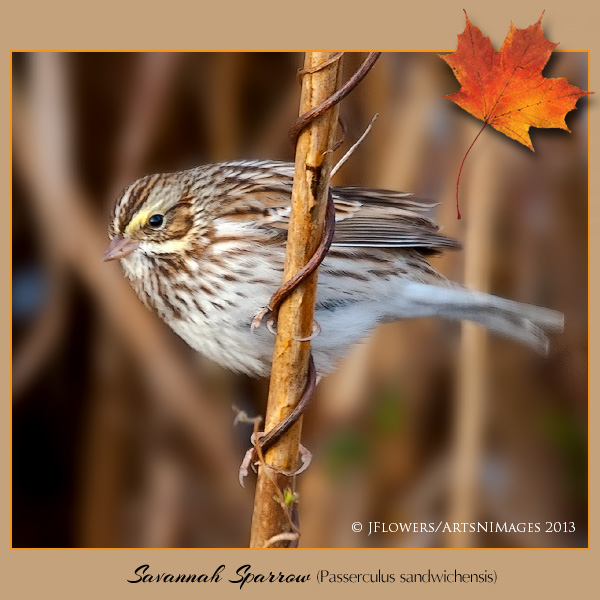
Savannah Sparrow

This lovely Savannah Sparrow made a brief appearance allowing me one image before darting off into the unknown. I had been “graced” with its brief visit.
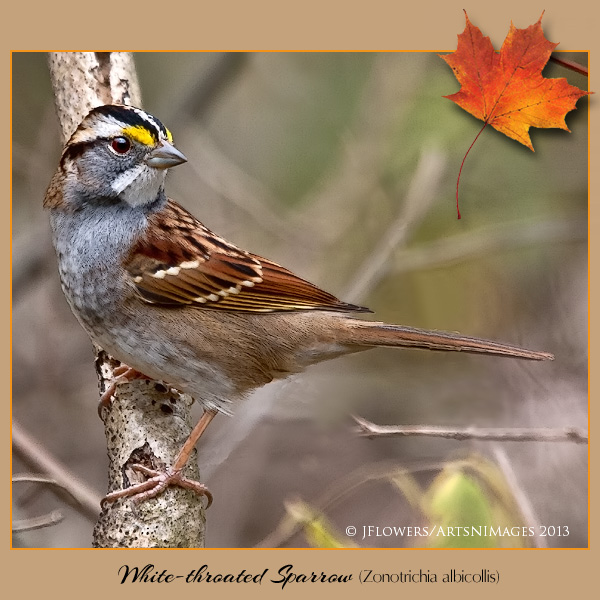
white-throated Sparrow

“Standing Proud” can be well referenced to this handsome White-throated Sparrow. Common Yes; but always a pleasure to observe and photograph. His Majesty had blessed me with his presence this fine day!

type leafSo I conclude sharing some of my “secret haunts” with my birding, photographic and good friends.  I will perhaps be pistol-whipped by some of my peers for doing so, but sharing has always been my nature and I really didn’t give away the exact locations where I know the birds will be time day after day and I will leave those for you to discover on your own with the dedication I had put into these areas.

I only ask that you keep any disturbance to a “bare minimum” and respect the posted areas of the watershed and other locations.  Wetlands are sensitive areas so leave no footprints.  Birding and photography needs to be kept to the roadways.  Large birding social gatherings within intimate surroundings are a “peeve” of mine and I find them as detrimental to the species as the abusive use of playback or recorded bird songs during the breeding season so I also ask you keep your visits to the small gatherings of a few friends.

I hope you enjoyed my efforts……..Jim Flowerstype leaf R

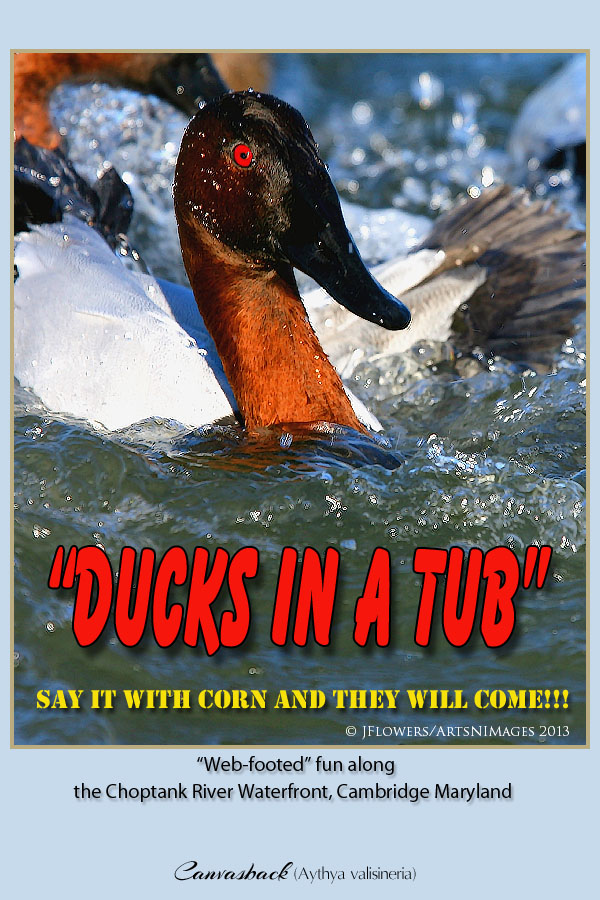
“DUCKS IN A TUB” … Say it with corn and they will come!!!

Posted by Jim Flowers on November 23, 2013
Posted in: Birding, Birds, Travel. Tagged: Cambridge, Canvasback, Choptank River, Ducks, Eastern Shore, Maryland. 10 Comments

Ducks in a tub title image

Where else can one experience,  observe and photograph wild puddle and diving ducks “up close and personal”; and the price of admission is simply tossing a little corn to stimulate their appetites and interest….    This is a must see and visit for anyone interested in waterfowl and especially those seriously “Hooked on Quack”.

A few points along the Choptank River waterfront and within the city-limits of Cambridge Maryland have been catering to such addictions over the past many years. My first introduction to this “mid-winter” extravaganza took place about 10 years back and I was totally amazed and hooked for life.    I had been enlightened about the “web-footed frolic” by a photographer friend from National Geographic several years before I first experienced this sight on my own.

My initial “ducky” adventure began with a trip down to Maryland’s Eastern Shore and a visit the Blackwater National Wildlife Refuge to attend a photography exhibit during the annual open-house of the visitor’s center. As I explored the hall and the photography on display,  I noticed numerous images of “diving ducks” and many seemed to have been captured at one special location.   My curiosity was about to kill me and I longed to know just where these fantastic pictures were taken.   I strolled through the photographic displays casually chatting with the exhibitors and commenting on their work.

Most photographers are pretty “tight-lipped” about their sources so respectfully I didn’t question their means. Near the end of my visit,  I decided to purchase a new migratory duck stamp from the refuge store and during the purchase I made a comment to the sales woman about some of the Canvasback images I had admired and I sure would like to know where they were taken. She immediately smiled and replied,   “Those are from Oakley Street over on the Choptank waterfront!”;  as if there was no secret and this was certainly not the first time someone had asked!  She then filled me in on the annual winter event and that I shouldn’t miss out.

On my way out of the show, I stopped to admire a large portrait of a Great Horned Owl and met photographers,  Larry Hitchens and Curtis Brandt.    I commented on the owl and then asked if either had any information or directions on how to get to Oakley Street.   Curtis smiled and said he was on his way over there and I could follow him!   So it began;  two great friendships and a heck of a fun yearly winter experience.

Besides Oakley Street, Curtis gave me a short tour of a few more local “hot-spots” along the waterfront. Over ten years have now passed, and my knowledge of the area has grown by leaps and bounds. I found the Oakley Street location popular with birding enthusiasts, avian photographers and tourists;  along with the locals and their children who enjoyed feeding the ducks and this seemed to have been the case for many seasons and long before my first visit. I have even seen duck hunters, still clad in their camouflage from the morning hunt,  stop by to take a gander at the “spectacle” and variety of species present.

Photogs image

Duck photographer’s wall of shame???  “Perhaps a little”;  but I’m as guilty as the rest!!!!! But then again,  where else can you take a camera and have “all of your ducks in a row?” (Pun intended)

The “wall of shame” is sort of pet name given by a few of the waterfowl photography purists who insist on a wilder and more natural setting.   However, these birds are wild and just a little “belly satisfaction” has been guaranteed over the past years by the seemingly constant food source delivered by their human visitors.  (Notice the can and bag of corn in a couple of the above images) Photographically speaking,  it’s a wonderful place for those of us “focal length” challenged to easily fill the frame with even the most modest of camera and lens combinations.

Don’t let the “big guns” pictured above fool you.   These folks are mostly after flight shots of distant ducks, and not those playing less than a few feet from the wall.   You can take awesome detailed images with your smart-phone or family “point n shoot” with little effort.

“Bird in flight” photography seems to be the craze and almost an obsession with today’s waterfowl photographers,  especially since the advent of the digital camera,  and especially those cameras capable of “machine-gunning” exposures with extremely high frame-per-second rates…

Back in the old days of film, that could get rather expensive and quality seemed more important than quantity.    That’s not saying the digital realm is any easier, as you still pretty much have to have a grip on exposure and lighting. Obtaining a good exposure of a fast flying bird with a changing background can be a challenge for any photographer.   Then you add a light bird against a dark background or vice-versa which can wreak havoc on the “reflective” in-camera meter giving forever changing exposures and thus causing the photographer to constantly keep a thumb on the exposure compensation dial!

Many,  including yours truly,  prefer to use a “handheld” exposure meter and take an “incident” reading of the actual light source and shoot in pure manual eliminating a lot of the guesswork in obtaining a workable exposure.   Back-lit subjects are a whole other ball game! Back to the “wall of shame” and again “perhaps”,  but I have seen quite a few images from this location published and bless the covers of local and national magazines.

ducks ducks and more ducks

Canvasback 7

Seven primary species of ducks make up the “hungry clan” that can be found just inches away from the wall on the Oakley Street waterfront along the Choptank River.   These include the Canvasback,  Lesser and Greater Scaup,  American Wigeon,  Red Head (a few on occasion), Mallard and the American Black Duck.   Canada geese are often present and a rare visit by a few Tundra Swans can add to the menagerie.   Then there are the “surprises” that can occur by perhaps a Eurasian visitor or two making an unexpected debut.

“You never quite know who will show and join the fun!” For those birding enthusiast with spotting scopes;  or photographers with the longer lenses, species like the Common Goldeneye,  Buffleheads,  Long-tailed duck  (Old Squaw),   Scoters (Surf and the less common White-winged and Black) and others can be observed farther out in the main river.   I can remember a rare Barrows Goldeneye present for a few days one year. The above species seem rather timid and rarely make an appearance close to shore.

A host of Gull species are forever present and some can be quite interesting.  A fly over by a Bald Eagle (common on many occasions) will add excitement to the moment by causing the ducks to take flight to avoid becoming “a sitting duck” (more pun intended) and an easy meal for a hungry raptor.   The ducks will launch, circle and will return soon as the danger has passed giving the flight photographers opportunities for excellent captures of their return and landing approach.   But for most visitors to the Oakley location and other points along the river,  the Canvasback is king!!!

canvasback title

Canvasback 1

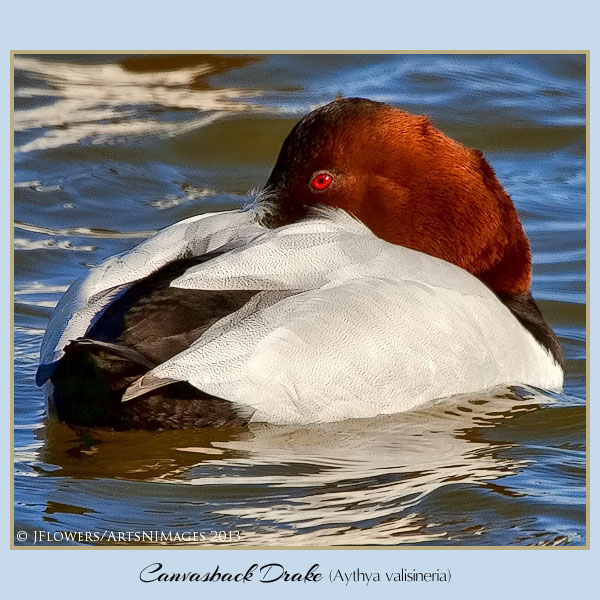
Of the largest “Bay Ducks”,  the Canvasback is the prize for visiting waterfowl enthusiast and “ducky” photographers along the Cambridge waterfront.   The drake (male) is the standout with a beautiful deep brownish/red-head and white back feathers.

Diver hunting is steeped in tradition along the Chesapeake Bay and the “Can” was the top draw. During the fifties roughly 250,000 Canvasbacks wintered along the Chesapeake Bay and represented one half of the wintering North American population; and then by the mid nineteen-eighties,  only about 50,000 called the Chesapeake their winter home.”

Throughout the 19th century the Canvasback was considered excellent table fare and the birds were commercially harvested using large-bore shotguns and batteries of cannon and “punt” guns to assault the large rafts of canvasbacks on the bay,   killing dozens of birds with a solitary shot.   The dressed birds were then shipped to restaurants from Baltimore to Boston and all in between.

This unregulated over-harvesting was almost an end to the once abundant population along the eastern seaboard.  Commercial hunting came to an abrupt halt with passage of the Migratory Bird Treaty Act of 1918, which empowered the federal government to set seasons and bag limits on the hunting of all migratory game birds.

Canvasback 2

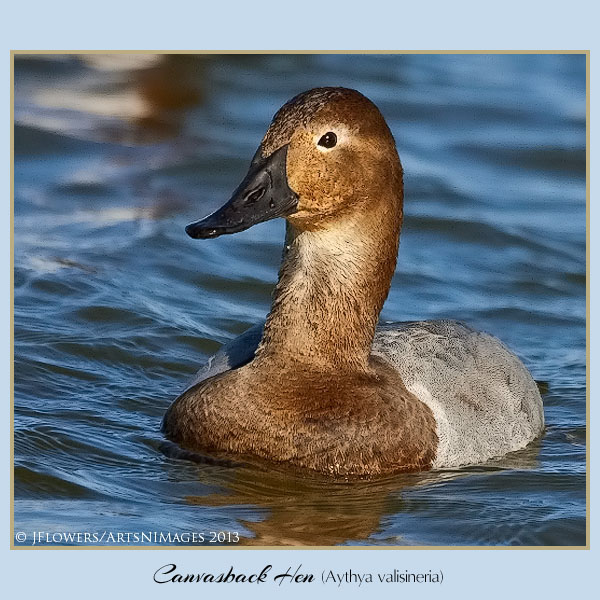
Recreational hunting today has an impact;  especially the illegal hunting of females due to hunters misidentifying the canvasback hen as a female mallard,  “but then if you can’t identify your game,   you shouldn’t hunt without supervision and someone calling the shots.”    The hunting impact of today is only minor compared to that of yesteryear.

At present,  habitat degradation (wintering, migratory and summer nesting grounds) and the decline of water quality in the Chesapeake Bay due to increased sedimentation from erosion has caused a dramatic decline in Submerged Aquatic Vegetation (SAV), including wild celery (Vallisneria americana);  a main staple of the canvasback by reducing light penetration.

This and other toxins entering their food supply along with disturbance from shoreline development and recreational activities has become a detriment for canvasbacks as well as many other species of waterfowl.

Canvasback 5

It’s not all “gloom and doom” for the Canvasback and the Chesapeake Bay.   The Chesapeake Bay Foundation is the leading organization enlisted in massive restoration projects for water quality,  wetland habitat and fisheries restoration and has all the neighboring states involved.

Many recreational hunters are taking a more active role today with adherence to the stricter bag limits and with either actual physical involvement in habitat improvements or with financial contributions to many of the leading edge conservation organizations such as Ducks Unlimited and Delta Waterfowl.

Perhaps one day in the future we will again witness huge clouds of canvasbacks filling our sky’s over the Chesapeake Bay!!!!!

Canvasback 4

Canvasbacks are normally the latest to arrive along the Choptank River waterfront,  but this is based on weather and food sources available along their route of migration.  I have observed the first birds as early as mid December or as late as mid January.

Last year (2012) it seemed to be near the end of January before their numbers peaked and their presence looked to be down a little as well.   But perhaps they may have been scattered throughout more locations along the river and bay.

Canvasback 3

No matter their numbers present,  they’re always a wonder to observe, photograph and share a few tidbits of corn with.    Watching their feeding behavior is a joy in its own right as the splashing frenzy of red and white brings life to the Choptank River waterfront.

Canvasback 6

Canvasback Notes

The preferred breeding habitat of the canvasback lies within the Prairie Pothole Region of North America and extends northward through the sub-arctic river deltas in Saskatchewan and the Alaskan interior.   They prefer to nest over water on permanent prairie marshes surrounded by emergent vegetation,  such as cattails and bulrushes; which provide protective cover. Canvasbacks migrate through the Mississippi Flyway and then branch off to their wintering grounds in the Mid-Atlantic region and the Lower Mississippi Alluvial Valley (LMAV).

The birds farther west,  use the Pacific Flyway to wintering grounds along the coast of California.   Historically,  the Chesapeake Bay wintered the majority of canvasback population within the United States. Today the canvasback population seems to have stabilized and seem to be  increasing, although they are no where as common as they once were.  Scientific research and species studies have now shown that by the 1970’s  four fifths of the ducks’ diet was made up of Baltic clams, which are very common in the Chesapeake Bay.

The ducks have been able to adapt to the decline in SAV by changing their diet.   Unfortunately,  redhead ducks,  which also feed on SAV tubers,  have not been able to adapt, and their populations continue to remain low.

American Wigeon title

american wideon1

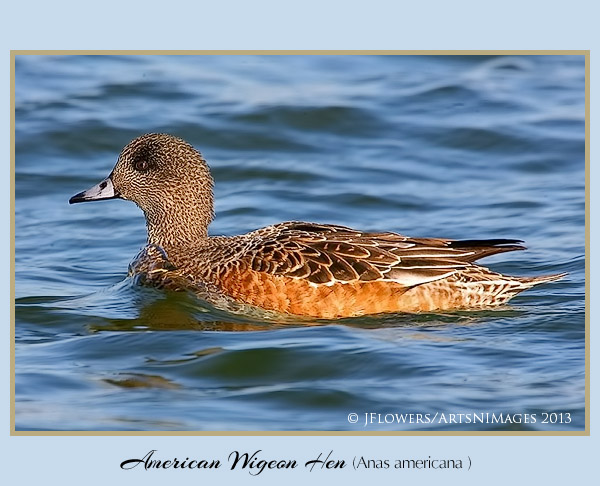
One of the earliest duck species to arrive at the Oakley Street location,  the American Wigeon is forever a welcome sight.   “Colorful to say the least”,  along with their high-pitched whistling “squeaky toy” for a call,  they are a charm of sight and sound.   I have always found this species intriguing.  And when I use the term “colorful”,  I’m not just referring  their appearance, but their behavior as well.

They are constant aggressors,  sparing with the other ducks for attention and food. In the beginning,  I found their presence along the salt and brackish Choptank River waterfront somewhat a mystery.   Growing up in Texas,  the Wigeon I had come to know,  mostly inhabit shallow freshwater wetlands, marshes,  rivers,  ponds and lakes.   Perhaps word got out about the popular and free “Corn Soup Kitchen” at the Oakley location.

But after a little thought,  I could see where salt and brackish water habitats made sense and would not seem uncommon during the wintering season.  I tend to forget that most of our waters in Texas hardly if ever see any ice during the winter months.

american wideon4

American Wigeon numbers can vary at Oakley.   I’ve seen days with less than five present and others with more than two dozen swimming around looking for a free meal. The birds always seem to be in pairs as well.  If you see a male,  you will normally see a female close by

The only other location that I have witnessed larger numbers of wigeon besides Texas was a small creek near my home here in Pennsylvania.   It was not unusual to observe fifty to sixty on any given winter’s day.  They are a prevalent species in the Mid-Atlantic and perhaps I haven’t looked hard enough or have been the wrong locations.

american wideon3

I remember friends here in the area using the name “Baldpate”  in some of our early hunting conversations and had no idea as to the reference.  Once enlightened,  it made sense due to the white bald-like marking on the drake wigeon’s forehead as pictured above.  I guess this just goes to show how limited my waterfowl knowledge and vocabulary had been in the past. But then I still refer to the Long-tailed duck as the “Old Squaw” and Lesser and Greater Scaup as “Bluebills”   I would also always spell the name wigeon with the “d”…(widgeon)!!!!  I suppose I’m not alone because my “spell-checker” is going nuts trying to insist on adding the “d” at present!

american wideon2

American Wigeon Notes

The American Wigeon breeds throughout the north-western portion of the United States, with the heaviest concentrations in the Dakota’s,  Montana,  Idaho and Washington State.   Breeding pairs can also be found as far south as northeastern California and northern Colorado and as far north as Alaska and the Northwest Territories in northern Canada.

During migration the American Wigeon can be found in most of the lower 48 states and their route will take them down the Atlantic and Pacific coasts to the Gulf of Mexico and beyond; extending south through Mexico and Central America,  to the northern parts of South America, as well as the Bermuda Islands and Hawaii.   They are rare but regular vagrants to Britain and as far as northeastern Siberia and Japan. During the winter months,  they are found most often near freshwater wetlands,  lakes,  rivers, marshes and protected estuaries and bays, with abundant plant-life for feeding.

American Wigeon have a largely vegetarian diet consisting of the stems,  roots and leafy parts of aquatic plants,  such as musk grasses and bushy pond-weed;  as well as grasses and various agricultural plants. To a lesser extent,  they will forage on various aquatic insects, such as damselflies and caddis flies,  as well as certain crustaceans,  mollusks and terrestrial insects, including beetles.  “And let’s not forget corn!”

Greater Scaup title

greater scaup d1

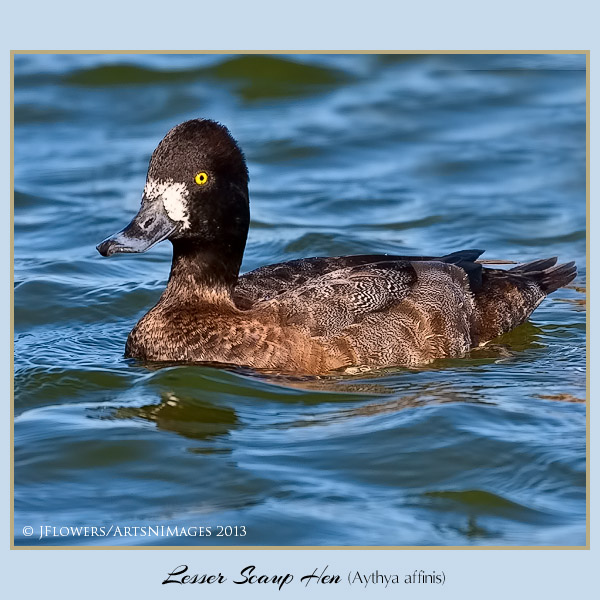
Another of my favorites,  and “Bluebills” as I call them,  are fun to observe and photograph.   The Lesser Scaup seem to outnumber the Greater Scaup during my visits to the Choptank waterfront.  They can be hard to tell apart as well,  but following a few guidelines makes the ID a little easier. The Greater’s head is more rounded and less “peaked” than that of the lesser and I find the greater with more whites.

The head and neck of the Greater tends to have the dull green sheen as well but that’s not always a 100% reliable for a proper ID as I have photographs of the Lesser shown here with that same dull green sheen.   The Greater has a wider bill with a larger nail that tends to be more triangular,  whereas the Lesser’s bill is tapered with a smaller nail.   The white wing stripe of the Greater extends to the primaries while the white wing stripe of the Lesser is only to the secondaries.   The Greater female also has a larger white patch at the base of the bill.

Do I have you totally confused here,  or can we just agree a scaup is a scaup!!!

greater scaup h1

My first encounters with the scaup species where back in my hunting days along the Potomac River near Fort Washington in Prince Georges County Maryland and then along some of the creeks in Charles and St. Mary’s Counties farther to the south.   I had seen scaup in Texas and Louisiana,  but as a hunter my primary quarry was that of the Teal,  Pintail,  Mottled Duck, Mallard and an occasional Wigeon.

greater scaup h2

I since have pretty much given up the gun for the camera and thoroughly enjoy exploring and photographing the variety of species that bless our natural world.   I now enjoy a 365 day waterfowl season.   You can still “camo” up,  toss out a few decoys in the early morning marsh,  blow a few notes on the call and enjoy the hunting experience without firing a shot from the old scatter-gun! I still very much love the waterfowling tradition and miss it immensely,  but most of my hunting buddies are long  gone along with my dad who taught me the tradition and the respect for our natural resources.

Lesser Scaup title

lesser scaup d 2

Scaup Notes

The Greater Scaup’s preferred breeding habitat is on the ground by lakes and bogs and on the tundra near the northern limits of the boreal forest across Arctic and sub arctic regions of northern North America,  Europe and Asia.  Greater Scaup populations have been on a steady decline in North America since the 1990’s.   Biologists and conservationists are unsure of the reason, but some believe that a parasitic trematode found in snails may be to blame.

lesser scaup h 1

The Lesser Scaup prefers inland lakes and marsh ponds on tundra from Alaska through western Canada to western Montana.   A few breed east of James Bay and the Great Lakes. Notable breeding concentrations,  with more than half a million birds at the peak of the season, can be found in Alaska, within the woodlands of the McKenzie River valley and on the Old Crow Flats.

lesser scaup d 1

Both the Greater and Lesser Scaup migrate south using the Central and Mississippi Flyways and then branch off from there.   Migration begins shortly after their young have fledged and the birds return to the breeding grounds in the early spring;  usually during the month of May. Lesser Scaup are typically found in freshwater or slightly brackish habitats and unlike Greater Scaup,  rarely are seen offshore when unfrozen freshwater habitat is available.

Thousands of Lesser Scaup winter each year on the Topolobampo lagoons in Mexico, and even in the southernmost major wintering location,   Ciénaga Grande de Santa Marta in Colombia where hundreds of birds can be seen.

redhead title

Redhead 1

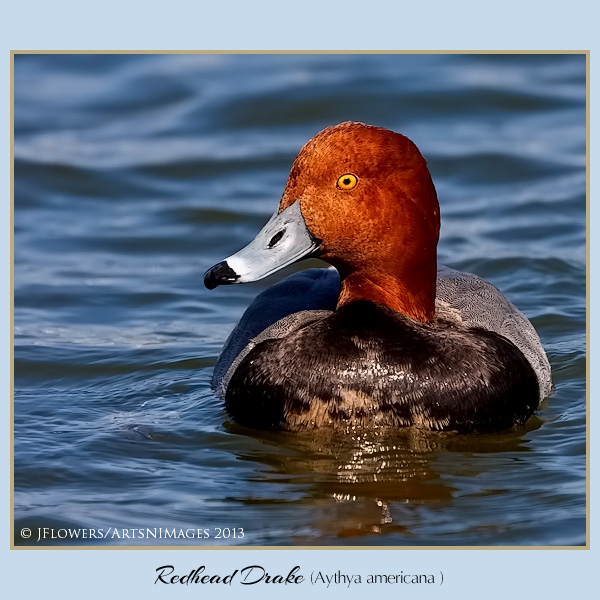
The Redhead duck is a favorite among the photographers and birding enthusiasts at the Oakley Street location, although only a few may be present at any given time during the peak of the activity.   They blend in well with the hundreds of canvasbacks and can be difficult to spot. I cannot recall observing more than two to three males during my visits and the females are even harder to distinguish from the female cans.

I usually find more members of this species in some of the more remote Blackwater Refuge ponds,  creeks and slews in that area. The largest concentration I have ever witnessed in the north-east was in a small lake along Interstate 81, just above Cortland New York and the observation took place just this past fall on my way to Syracuse.  There were hundreds and it was a sight to behold.

I have also observed several dozen in the past near my home,  on Lake Marburg at the Codorus State Park and along Conewago creek in the nearby area. Another productive area to find the Redhead is along the Little Juanita River and especially along the tail-race below the Raystown Lake Dam.  I have seen nice numbers present quite a few times,  but the birds seem to be in transit and only remain for a short period.

Redhead 3

I have observed decent Redhead numbers in Texas and Louisiana,  but more often on the large freshwater lakes like Toledo Bend,  Sam Rayburn and Livingston in the eastern part of the state than along the coast.  Toledo Bend sits on the border of Texas and Louisiana and maintains large open areas of water and lots of aquatic vegetation which these ducks prefer as a food source. I do remember spotting a small raft of these birds on Offats Bayou on Galveston Island a few years back. No matter the location, the Redhead is a wonderful and colorful subject for the avian photographer!

Redhead 2

Redhead Notes

Along with the diving ducks above,  Redheads breed in the northern and northwestern prairies of the United States and Canada to Alaska in the north and Colorado to the south. Their preferred habitat includes marshy freshwater lakes,  ponds,  slow-moving rivers and wetlands within the prairie regions.   The primary diet of the Redhead includes the leaves, stems,  seeds and roots of aquatic plants.   However many aquatic invertebrates are also eaten,  especially during the summer months.

While also using the Central and Mississippi Flyways as the initial routes of travel,  the Redhead winters on sheltered salt and brackish coastal bays and estuaries and inland lakes across the southern US,  from California to Florida and south into Mexico.

occasional sightings

Although the above species are the most popular with visitors and the photographers at close range,  the number of species present on the river can be amazing.  Birders and their “high powered” spotting scopes have the best opportunity to add a new subject to their “life lists” at any given time by scanning the distant waters!   But on rare occasions,  these somewhat timid species find their way close to shore for a picture or two and nearby observation.  Also keep a keen eye out for the rare or not so common species that appear on occasion.

Other popular duck species along the Choptank River include the Common Goldeneye, Bufflehead, Ruddy Duck,  Hooded and Common Merganser,  Long-tailed Duck (Old Squaw) and White-winged,  Black and Surf Scoters.  And then of course,  the Mallard and American Black duck can be seen at any time.

Swans include the Tundra and an occasional Mute while Canada Geese seem to always be present nearby and I have observed an Atlantic Brant at a nearby location.  I will highlight a few of the other species I have been able to photograph over the past years at the Oakley Street location.

surf scoter title

surf scoter 2

The Surf Scoter or “Skunk-headed Coot” is my favorite and most colorful of the “Scoter’s” and a fun find along the Cambridge waterfront.  You normally have to look far out into the river to see this species.

Upon returning from a Thanksgiving trip to the Chincoteague National Wildlife Refuge,  friend Eric Gerber and I decided to stop and visit the Choptank waterfront to check and see if any of our duck friends were present.  It was still very early for the “divers” but we thought we’d take a gander in any case.

We parked at the Oakley location and noticed a Surf Scoter family rather close to shore, just to the west of the concrete wall and swimming in  a westerly direction.  So we hopped back into our vehicles and drove to the next street over with shoreline access, parked and slowly walked to the waterfront with cameras in hand hoping to get positioned before the scoter’s approached.

We had to literally skulk and hide along the concrete bulkhead and wait for the birds to come into range.  After we managed a few captures, the birds discovered our presence,  bolted and made a hasty retreat.  Eric by far got the better pictures with a longer lens,  but I was happy just to get a close glimpse and a few “snaps” of these beautiful birds, more less any “great” images.

surf scoter 1

The Surf Scoter is a black and white sea duck with a boldly patterned head and is common along the Pacific and Atlantic coasts during the winter months.  It breeds in the shallow lakes of the Boreal forest and tundra of the north.  However the young “non-breeding” and immature birds may decide not travel to the breeding grounds and spend their summer primarily along marine coasts southward to Baja California and New Jersey, where they frequent bays and estuaries. I have spotted immature birds along the Jersey shore on many occasions during my spring and summer travels for shorebirds.

tufted duck title

“Accidental Exposure”,,, Yep!  Quite by accident;  and I didn’t realize I had taken his picture until I returned home and was going through the images during my post-processing. The Maryland birding “list-serve” was hopping with sightings of this rare visitor back in 2009 who breeds across Eurasia, from Iceland and the British Isles and east across Russia and Siberia to the Kamchatka Peninsula and the Commander Islands.

Tufted duck

Who would have imagined he’d been lounging with a flock of Scaup along the Choptank shoreline,  right at the Oakley Street hangout!  There were just a few of us hardcore avian photographers there braving the winter chill with no one from the “birding crowd” present to enlighten our experience.  But then most of the sighting reports I had read took place near the Holiday Inn on Kent Island and the Narrows!

As a somewhat novice “birder”, (and I use that term loosely) it would have been difficult for me to isolate and ID this guy within the hundreds of “look-alike” ducks cruising the wall looking for a free meal!  I may know my ducks,  but finding the “Dennis the Menace” of the waterfowl world takes a keen eye and a lot more knowledge than I had at the time!  But Wow! “There he was in all of his glory and I had to be in front of the computer to realize my fortune!

The drake (male) tufted duck closely resembles his counterpart, the ring-necked duck.  The primary distinction is the tuft of feathers that fall behind the head. Additionally, his sides are white rather than gray and the bill lacks a white margin at the base while in flight a white stripe at the back of the inner wing is displayed.  The female is similar in appearance to the Scaup hen, but is blackish-brown with a smaller patch of white at the base of the bill.  At the back of the head, there is a small protuberance of feathers, which is much smaller than the male’s. There are no breeding records of tufted ducks in North America

Tundra Swan

Tundra Swan 1

The Tundra Swans were a first for me at the Oakley location a few years back!  I normally see these birds feeding in the fields along Egypt Road en-route to the Blackwater refuge or during a fly over above the Choptank River waterfront!  On this occasion,  I guess curiosity “got their goat” and they wanted to see what the ruckus was about with the huge rafts of ducks so close to shore! Or perhaps what these crazy humans were doing while shivering in the cold.

I watched them land a few hundreds out and slowly make their way to shore! Once they discovered the “Good Eats” they quickly made themselves right at home and even were rather aggressive towards being first in line for the “yellow gold” being tossed into the drink! This was as close as I had ever been to a Tundra Swan.  I was tickled at their personalities! You wanted to reach out and pet them!

They’re amazing birds to observe, especially in flight as they portray the “Jumbo Jet” of the waterfowl world and I love their “haunting” calls.  The image above is one of my favorites of the encounter. There were actually 3 of them close to the wall.

goth duck

So who is this guy???  Is it a Mallard?  “No, it’s a Black Duck!”  NADA!! “It’s both!!”  Ya Think??  Yeah, it’s both!!  At least I would guess so with the characteristics of both species all in one nice package.   It could be the new “In Thing” within the waterfowl world!  I’ll tell you though…”It was the biggest darn Mallard I had ever seen!!!   But then I have been known to see rather large Eastern Wood Pewee’s as well.  Talking about an oxymoron… A large/pewee?????

mallard-black mix

I figured I’d toss this “Dennis Rodman” duck image in for good measure and show a little more of the diversity along the waterfront!  Plus it’s a good “kick-starter for the next segment of this article which adds a little spice and good wit!  “Now for the fun!!!!”

Ice Capades

winter wonderland

“Ice Capades”  Not your typical Peggy Fleming or Dorothy Hamil Affair!!!  But, “just as Entertaining and with unlimited belly aching laughs!”…

Butt slides,  belly flops and bill busters abound during the performance;  all on the newly formed “Ice Rink” along the Choptank River waterfront in beautiful downtown Cambridge Maryland… Yes Sir Folks!  “Gather the kiddies,  Grand Ma,  Grand Pa and the Mutt too!”

And don’t forget a sack of corn for that meager price of admission.   All will be thoroughly entertained by the ballet style antics of the web-footed performers as they participate in a game of graceful and precise landings not unlike that infamous British Olympian “Eddie the Eagle.”

telemark landing

It’s been a while since we’ve had had a “real winter” with temperatures cold enough for an extended period of time to bring the ice to the Choptank River waterfront of Cambridge Maryland.  But when this happens,  Oakley Street takes on a whole new perspective with a comical twist as the visiting waterfowl lounge on the ice with the hopes of a morsel or two of corn tossed by their human onlookers.  And then of course some type of disturbance,  usually an Eagle flying overhead,  will cause a massive eruption of the flock to take flight and then return as soon as the threat has passed.

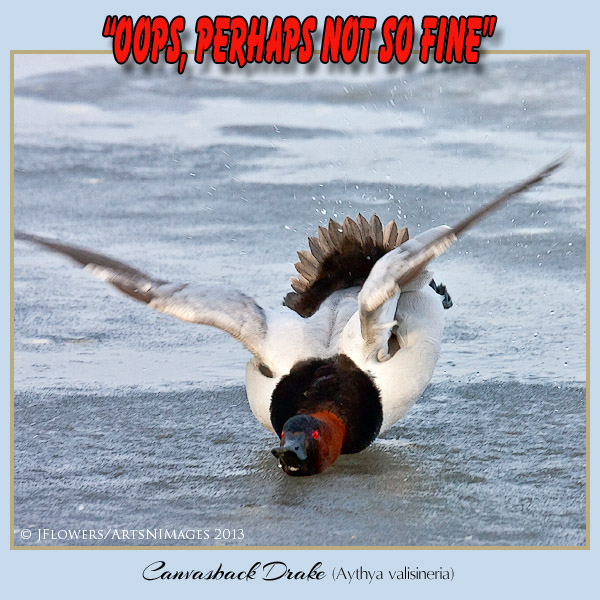
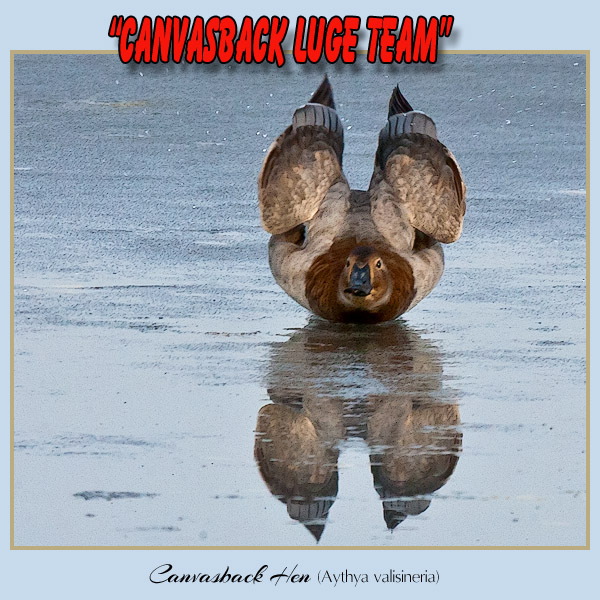
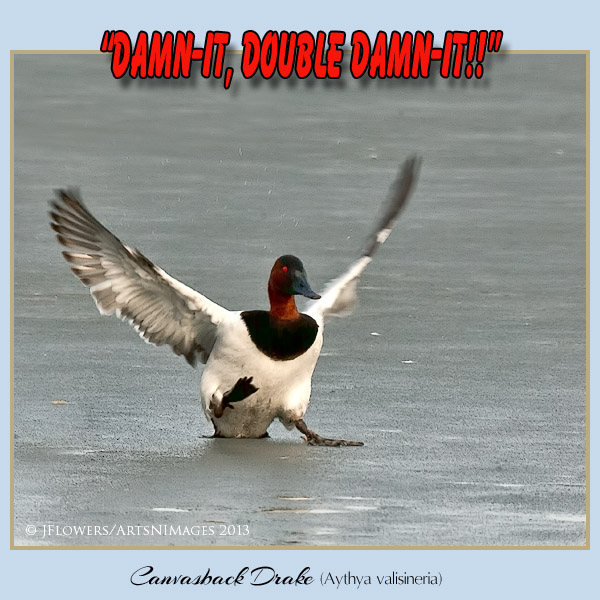
That’s when the fun begins! Watching the ducks return and then attempt some sort of sane landing on their slick runway will bring tons of chokes and almost painful laughs as these creatures make their approach and end up anyway but the right way after touching down on the ice. The Mallards can do this with an ease with the Wigeon coming in a close second,  but the off balance bulk of the Canvasback will bring a glowing smile and chuckle to even a funeral attendant.

perhaps not

Several years back I had made an early afternoon trip down to Dorchester County Maryland and the Blackwater area hoping to photograph the evening Short-eared flight.  I had a few hours to waste so I decide to stop by Oakley Street and take a gander of what might be happening along the waterfront.  I had no idea that the ice had set in so thick.

As Usual, the ducks were all there  gathered at the wall and so was friend Brian Schmidt from the Smithsonian Institution along with a big grin on his face from ear to ear.  He had a jump on me,  watching and photographing the hilarious show.  It wasn’t but a short while and another disturbance took place forcing the birds to once again take flight.  Then as is the norm, the flock circled to make the up-wind approach directly towards us to allow some fantastic and belly-splitting photography and laughter.

I will mention that laughing while trying to concentrate on exposures and composition is not an easy chore.  But it was a lot of fun!

canvasback luge team

SO the next time we get an extended period of  “hard freezing” days you might just plan a trip down to Maryland’s Eastern Shore and the Cambridge waterfront; and maybe, just maybe you might just get to witness the “Funniest Show on Earth” and the “Duckiest Olympics”,  all just a few feet before your eyes!!!! Just don’t forget the price of admission!!!!!!

dammit

If you would like to see more of the fun, just follow this Link and enjoy a slideshow:

getting there

Getting to Cambridge and the Choptank River Waterfront is quite easy!  From points north simply head towards Ocean City on US Route 50 after the Chesapeake Bay Bridge and head south.  Turn right at the first traffic light, Maryland Avenue (first major intersection) after crossing the Choptank River and travel east across a drawbridge and follow the side-streets to the shoreline. (See Map Below)

From points south, simply reverse the directions and turn left on Maryland Avenue, just before the bridge across the Choptank River.

I have marked the points of interest/waterfowl viewing areas on the map.  All can be productive for observing the wintering waterfowl and all provide access to the waterfront with normally sufficient parking at the location or close by!  Both Oakley Street and Great Marsh Park are good for close-up photography with Oakley Street being the “highlight” of the area.

The circle near the marina at the eastern side of Long Wharf Park can be productive as well. Remember that all of these locations are located within residential areas so please be respectful at all times to any landowner’s wishes.  All it will take is one inconsiderate individual for the city of Cambridge to  post “No Parking”and/or “No Trespassing” signs and ruin this for all of us!!!

Waterfowl viewing map

photographically speaking

As I mentioned before, you don’t need to have thousands of dollars invested in photographic gear to reap the benefits of fantastic waterfowl photography along the Choptank River waterfront;  and especially at the Oakley Street Location.  The big expensive telephoto lenses are fine if you’re shooting flying or approaching birds  in the distance! (And you can afford the damn things)

Many times the birds will make an approach and land just a few yards out from the wall, so even the most modest of  telephoto zooms will do the job just dandy!  A lot of folks use a “fast” zoom in the 70-200mm range and the 300mm and 400mm primes are favorites too!  I, and many others will have two camera bodies available with a normal to medium telephoto range on one and a longer lens (500mm +) on the other for the distant work.

However,  the most important items for a successful Oakley outing are a good warm coat, gloves and a “sack of corn”…

Good light plays the key role for “Great” photography at these locations and the best light for photography occurs between 11AM and sunset.  For the “lovely blue water color”,  a sunny day is tops and for the best detail in the birds, and especially for exceptional detail in the whites of the Canvasback, a high-thin overcast is the ticket!  But a good technique and knowledge of exposure will yield good results on both occasions!  Shutter-speed and an adequate aperture are the main-stays for the flying birds!

I will mention that a strong northwesterly blow will all but ruin your outing so make sure to check the marine forecast before making the trip!

So what’s holding you back??  “Come on Down!!!”………….. Jim Flowers

“The Bitterns” Hide and Seek in America’s Wetlands

Posted by Jim Flowers on July 3, 2013
Posted in: Birding, Birds, Coastal Birds, Travel. 1 Comment


Bittern Title Image2

“Hide and seek in America’s wetlands” is somewhat an understatement with the bittern,  as a visual opportunity will most likely present itself as “Now you see me and now you don’t” or you may not see me at all!  Like the elusive Rails,  Bittern’s are secretive birds…  This is not to say the chance of observing and/or photographing a member of the bittern family is impossible.  Both the American and Least bittern are covert,  stealthy and blend well into their surroundings.  Their movements are smooth and precise while stalking prey in the wetland grasses and reeds.   Most common sightings of these secretive birds  usually occur during their flight from one location to another.

Another way of locating a bittern is by sound,  although I tend to find the American bittern not as vocal as the Least.  During the early spring,  I had read reports of a “vocalizing” Least bittern at the Union Mills Wetland located in northern Carroll County Maryland, very close to my home.  I visited the area numerous times during the dawn and late evening hours and heard the vocalizations on several occasions,  but without catching a glimpse of the bird.  I even tried a short duration of a recorded playback during one visit to no avail.  The bird would answer,  but he was perfectly happy with his well concealed location.

On another occasion,   good friend and fellow photographer  Larry Hitchens had located a Least bittern skulking in the grasses near the shoreline of the Bear Swamp Pool at the Bombay Hook National Wildlife Refuge near Smyrna Delaware.  Once he located the bird, Larry gave me a call on my cell phone to notify me of his find.  We met up and both sat and photographed the bird for over an hour while other refuge visitors and photographers drove by without a notice that the bird was there.  “They do blend right into their surroundings with their brownish streaked camouflage”;  and if not for Larry’s “eagle eye”,  I would have most likely missed the bird entirely .

American bittern sidelineWe were amused at the passer-by’s because normally if you stop and point a lens at something;  for the sake of curiosity, most folks will usually make it a point to stop to see what you are photographing or observing.  “This by the way drives Larry nuts…..”  I can see his frustration though,  because after spending a lot of time searching for those special opportunities,  having a social gathering show up and spook the subject and cause it to retreat and hide can be rather annoying and has happened on more than one occasion in the past.  National Wildlife Refuges on the east coast can be wonderful places to visit on weekdays,  but the weekends draw crowds and we both tend to avoid these popular public areas and look for remote  back roads and  “off the beaten path” locations to enjoy our photographic adventures

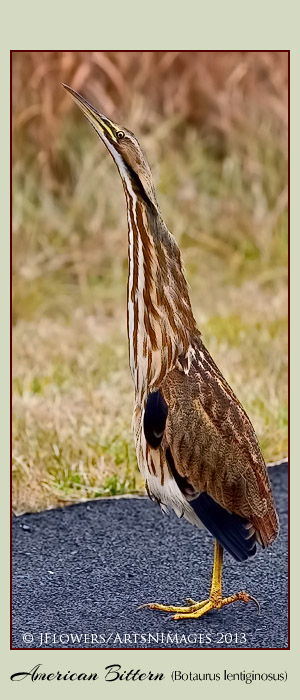
Finding a bittern can happen quite by accident as well!  I had completed one pass around Wildlife Drive at the Blackwater National Wildlife Refuge in Dorchester County Maryland and decided to stop for a break and a snack before my second loop.  I took a spur off the drive towards an observation area,  parked and was sitting and enjoying a sandwich when an American bittern flew out of the grass and landed not more than 15 feet from my vehicle on the black-top surface of the road.  (Pictured left)  Perhaps he was into peanut butter and grape jelly and wanted a bite?  But without a care in the world;  and regardless of the fact that I was sitting there,  he just strutted around and let me photograph him for about ten minutes and then off he flew not to be seen again…  This was the one and only American bittern I have seen, more less photographed on the east coast.  I know they are here,  but like with many of my “nemesis birds”,  I often suffer from not being at the right place at the right time,  or perhaps I need to have old “eagle eye” along more often.

Texas has been good to me allowing numerous opportunities to view and photograph both bittern species.  There is hardly a year  I can recall that I didn’t see at least a half-dozen of them during our springtime pilgrimages.  But the ratio of American bittern sightings to that of the Least bittern is still about 1 in 5.  However during the past  year,  the American bittern had unexpectedly taken the prize with more finds.

The American Bittern

american bittern title

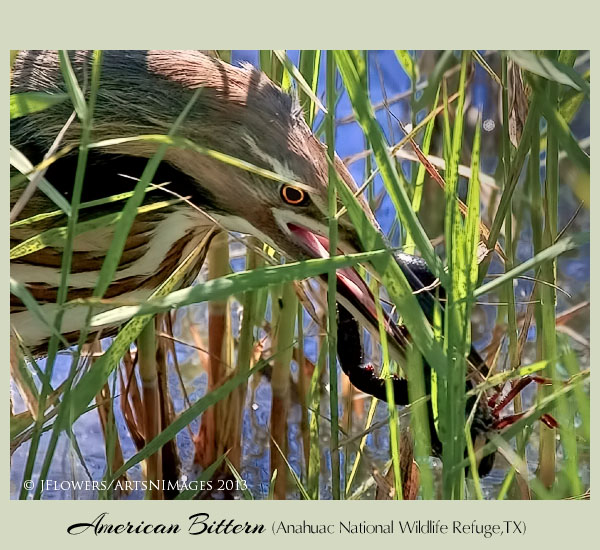
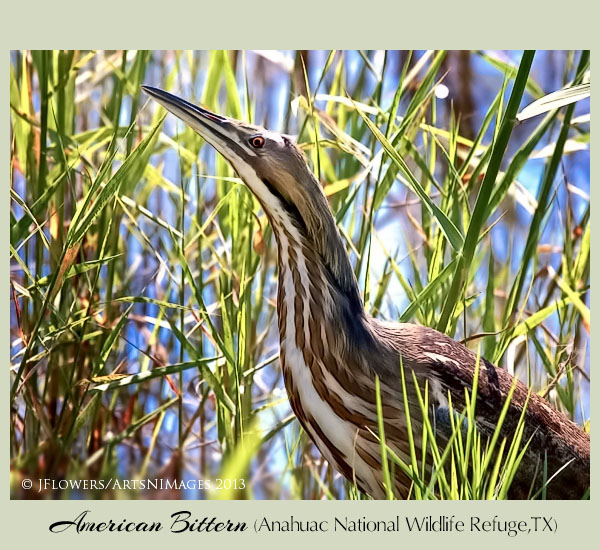
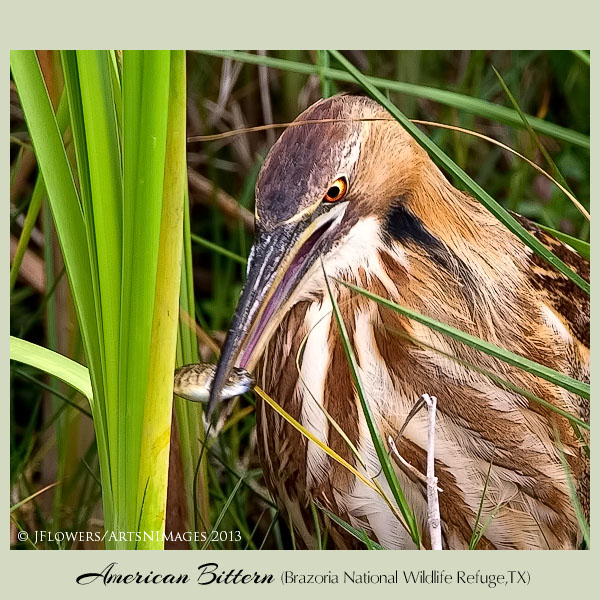
I can vividly remember my first encounter with an American bittern,  and the event took place at the Anahuac National Wildlife Refuge in Chambers County Texas,  just a twenty-minute drive from our residence during our visits home.  It happened along the Shovelers Pond loop near the entrance to the boardwalk.  The bird actually startled me at first glance as I had no idea what this strange large streaked thing was!  It was skulking in the grass with a crayfish in its bill. (Pictured below) ) These are not the best of images due to extreme back-lighting, but I felt the encounter was worth taking a chance with the camera.

american bittern 2

Unlike the Least bittern, I rarely find the American bittern along the popular Shovelers Pond loop,  but more often along the gravel routes and sloughs that lead to the remote Galveston Bay boat launch and Frozen Point.  As I noted above,  it’s quite easy to drive right past them without a notice of their presence.

american bittern 1A

On September 13th, 2008,  Hurricane Ike devastated the Texas coast and all but destroyed the Anahuac National Wildlife Refuge with what was recorded as a 22 foot storm surge in the Galveston area that sent flooding salt-water miles inland.  But with the infamous Texas resilience and persistence of the refuge staff and hundreds of volunteers,  the refuge has made a comeback to a somewhat normal existence and is getting better as time passes.  To have seen the refuge shortly after Ike and to see it today,  is what one would have thought impossible.

Two more Texas favorites are members of the Texas Mid-Coast Refuge Complex and include the Brazoria National Wildlife Refuge located in Brazoria County,  just east of the towns of Freeport and Surfside and the San Bernard Wildlife Refuge,  west of the town of Lake Jackson,  and sharing acreage within both Brazoria and Matagorda counties.  Both refuges allow ample opportunities to view both bittern species on a regular basis.

Between the two,  the San Bernard refuge is my favorite simply due to its diversity and the lack of “human kind” during most of my visits.  Even a weekend day can be spent in somewhat solitude,  especially during the early morning hours.  You can pretty much “bank” on spotting one if not several American bitterns along the 3-mile Moccasin Pond Loop which is included as part of the 8-mile Cocklebur Slough Auto Tour.

american bittern 3

Moccasin Pond holds smorgasbord of wading birds throughout the year along with a few very large alligators so keeping your distance from the water’s edge is highly advisable at all times. The pond didn’t get its name by accident either as venomous snakes are routinely present as well.  I have had my encounters with both snakes and alligators at this refuge with the latter projecting itself as a rather scary and “rude awakening” one early morning trying to get closer to an American Bittern near the pond shoreline.  The alligator did nothing wrong,  as he was just “doing his thing”  looking for food;  and I wanted no part of becoming his breakfast.  He was a “big fella”;  every-bit of 12 feet in length,  if not more!

I have found most of the American bitterns at the beginning of the Moccasin pond,  near its narrowest point and then a hundred yards or so beyond.  However,  you may encounter this species anywhere along the length of the pond.  Dawn and dusk are prime times for viewing, but the best light for photography is during the morning hours due to the angle of the sun.  A nice bright overcast can be wonderful and offer a full day of photography,  less the harsh light and back-lighting of sun-lit days after the morning hours.

american bittern 4

The Brazoria National Wildlife Refuge can be productive for both bittern species,  but if my memory serves me correctly,  the Least bittern seems to be “king of the hill’ and the most prevalent.  Unlike the San Bernard refuge,  Brazoria tends to see more visitors along with outdoor education aimed at school children.  I have noted many “outdoor classrooms” during my weekday visits over the past years and this is a wonderful thing!  It’s enlightening to see youngsters exploring the great outdoors instead of having their eyes glued to a video game.

However,  as with San Bernard,  early morning visits can be rewarded with lovely solitude and be shared alone with nature during its finest hours!  The Big Slough Auto Tour provides access to many areas along unimproved roads throughout a variety of habitats from coastal prairie to marsh.  Both bittern species can be found anywhere  along the Big Slough and refuge freshwater ponds.  Pictured below is a Brazoria American Bittern with a “catch of the day”

american bittern 5

A Brief American Bittern Biology

American bittern sideline 2The American Bittern is a member of the family ARDEIDAE which contains the groups; Herons, Bitterns and Egrets;  and follows the species order Ciconiiformes.   My encounters with the American bittern have been a “single bird only” experience and birding resources list the bird as “almost always solitary and can be difficult to see”…. The American bittern is “subjectively” migratory,  where as the birds in the more northern reaches of their territories and where the water will freeze, become strongly migratory;  and birds farther south in more tempered climates,  will remain all year-long.

The preferred breeding habitat of the American bittern includes fresh-water marshes with tall vegetation.  During the winter months they can be occasionally found in brackish marshes near the coast and managed areas such as wildlife refuges tend to be favored. They forage upon insects ,  fish,  crustaceans, amphibians, reptiles,  and small mammals.

Unlike most wading birds that “flush” when approached or threatened;   the American bittern will freeze in its place or hunker down until the danger has passed.  Disturbances by the boating public and acid precipitation degrading watery habitats of  sensitive marine life are both potential threats to the population, but the most significant threat is habitat loss due to our vanishing wetlands.   The population has declined throughout much of the United States.

The Least Bittern

least bittern title

“To say the Least” (pun intended) bittern is an easy bird to find,  even as common as the species may be,  would be stretching the truth on my part;  although I have experienced many encounters with this species.  I previously mentioned my latest attempt here near my home and within the Union Mills Wetland in Carroll County Maryland was a total bust.  This tiny member of the heron family is by far a master of visual deception through its ability to “blend in” with its surroundings and like the American bittern;  will freeze in its place at the hint of danger or presence of any approaching intruders.

It requires a keen eye and knowledge of the bird’s preference of habitat to begin looking for this species and then a lot of patience as well!  Many of the “refuge racers” looking for the obvious avian standouts will pass them by more often than not and its fine with me as it is usually to my benefit.

“Refuge Racer” is a pet name of sort that I use loosely to describe  visitors that travel the refuge roadways a little too fast to fully enjoy all the area has to offer.

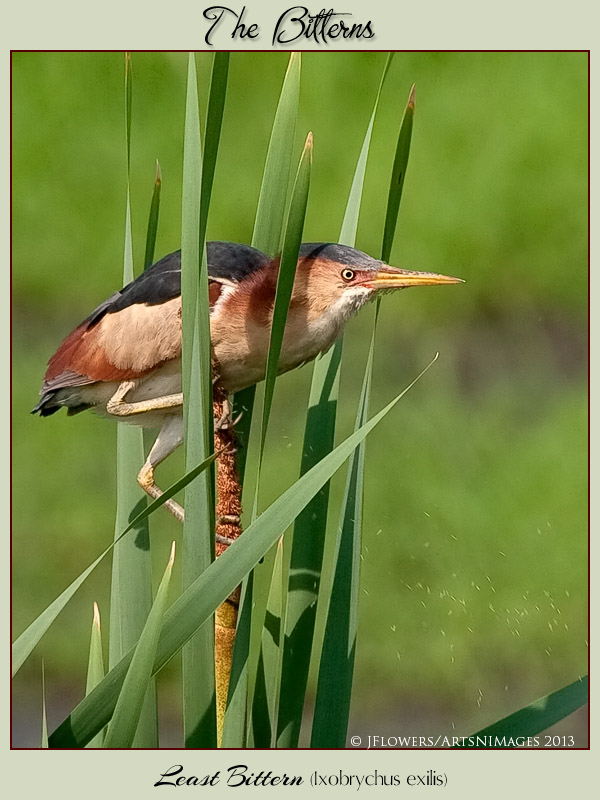
The image above was captured during a previously mentioned outing with friend Larry Hitchens at the Bombay Hook National Wildlife Refuge in Delaware.  Bombay Hook , along with other federal and state refuges,  and wildlife management areas in Delaware,  are excellent locations to seek and find the least bittern.  At Bombay Hook,  the Shearness Pool and Bear Swamp Pool are good starting points to explore for the least bittern.  Look for the thickest patches of reeds along the water’s edge and observe closely for a few extra moments for any unusual movement in the grasses and reeds.  If you spot a somewhat darker spot in the vegetation you might just discover this little guy. Sometimes they can be found out in the open along the water’s edge, especially just around dawn and in the late evening.

The Anahuac National Wildlife Refuge in Texas has been my “hot-spot” for the Least bittern in the past,  especially before Hurricane Ike and the most recent “human kind” improvements and the paving of the Shovelers Pond loop.  However,  now with most of the construction complete,  the refuge offers excellent opportunities to observe and photograph this species.

“Gone Fishing”

least bittern 2

The refuge vegetation is recovering well from the past salt-water contamination and once again creating prime bittern habitat for both species.  The image segments above, which I have titled “Gone Fishing”,  were captured along the Shovelers Pond loop during the early spring and prior to the hurricane’s devastation.

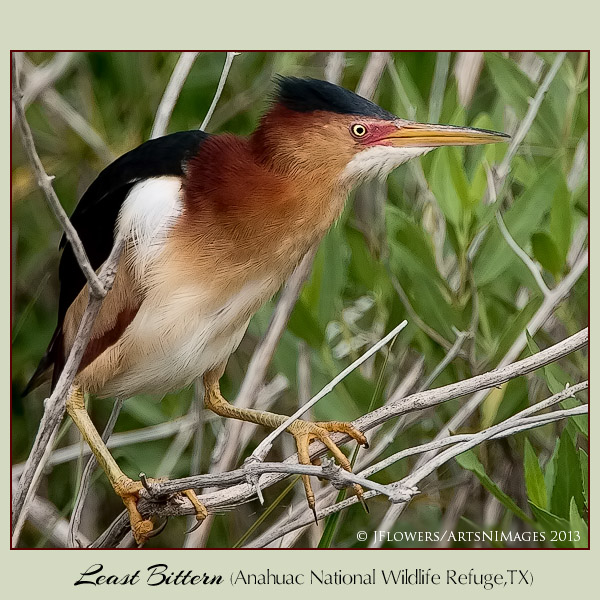
Other productive areas around the Anahuac refuge include the fresh-water ditches and sloughs along Cross Road and West Line Road (leading to a remote bay boat launch) and Frozen Point Road.  Just look for swathes of thicker vegetation and reeds.  The image below was captured at the junction of Cross Road and West Line Road.  This Least bittern was in his full breeding plumage.   Again,  all of these routes may offer opportunities for both species so look carefully and drive very slowly.

Anahuac’s Skillern tract is also a good candidate for both bittern species.

least bittern 3

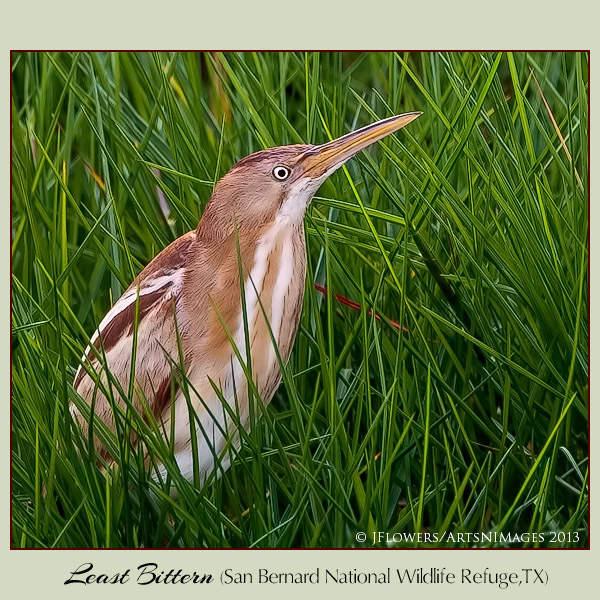
Again I have to give credit to the San Bernard National Wildlife Refuge for excellent opportunities for both bittern species and some of my better Least bittern “portraits”.   Both species can be found almost anywhere along the tour routes with freshwater ditches,  ponds and sloughs;  and tall patches of vegetation critical for concealment.  One of the better areas to look for the Least at the San Bernard refuge is near the end of the Moccasin pond where the road makes the first 90 degree left turn. Here you will find a narrow slough with tall reeds and grasses providing ideal bittern habitat.  The image below was photographed at the beginning of the Moccasin pond and just several yards away from an American Bittern.

least bittern 1

The final images of the Least bittern below were captured at the Brazoria National Wildlife Refuge along the main tour route and near the narrower sections of the ponds with the tallest vegetation.  Brazoria has numerous areas like this;  too many to list.  Unlike the solitude of San Bernard,  Brazoria can become quite busy with visitors on nice spring days so an early dawn arrival is best for finding this bird in the open.  You still have to travel slowly and look closely to observe them; a point I can’t stress enough.

least bittern 4

Sometime we get lucky and the light is just right with a warm morning glow;  and your subject participates and poses in his most flattering manner. (Below)  I never grow tired of photographing the bittern species;  no matter how many images I have archived away…….

least bittern 5

A Brief Least Bittern Biology

least bittern sidebarAs the smallest member of the heron group,  and the family ARDEIDAE;  and the species order Ciconiiformes,  the Least Bittern breeds throughout much of the central and eastern United States;  with the exception of the Appalachian Mountains.  However,  I have read or heard of sightings in some of the foot-hill wetland areas.

Its preferred breeding habitat includes dense fresh-water wetlands and brackish marshes that support cattails, tall grasses,  reeds and clumps of woody plants over deep water providing thick cover.  The Least bittern and American bittern can often be found occupying the same wetland area,  but experience little interaction because of foraging differences,  preferred prey, and breeding cycles. Unlike the American bittern that prefers the shallower marsh and wetland areas,  the Least bittern is perfectly at home in the deeper wetlands because of its ability to straddle reeds;  and can feed in water that would be too deep for the wading habits of other herons.

The Least bittern may be hard to find but is not rare by any means with up to 15 nests per hectare.  The nest consists of an elevated platform housing an overhead canopy,  and is built of emergent aquatic vegetation and sticks.  Males and females appear to help equally in rearing the young.

An interesting fact from the Cornell website is that John James Audubon once noted that a young captive Least Bittern was able to walk with ease between two books standing 1.5 inches (4 cm) apart. When dead, the bird’s body measured 2.25 inches (5.7 cm) across, indicating that it could compress its breadth to an extraordinary degree.

The Least Bittern was first described in 1789 by Johann Friedrich Gmelin,  a German naturalist, botanist and entomologist.

Jim Flowers

“Bloodroot” … War Paint and the Medicine Man

Posted by Jim Flowers on June 26, 2013
Posted in: Blooms. 13 Comments

Bloodroot title image

Exploring our natural world can be rewarding and an educational experience.  Things are constantly changing with the seasons so every outing poses new experiences and discoveries. Exploring and photographing wildflowers throughout the spring,  summer and fall months can yield a variety of species to keep the most avid nature photographer busy composing and clicking away at the camera’s shutter and capturing lovely colorful images of many shapes and sizes in a broad spectrum of habitats. But to the aspiring naturalist/photographer like me, capturing an image of a pretty wildflower is just a part of the adventure and fun.

Learning to identify the species,  their natural history, original origin (native or non-native) and adaptation to their habitat;  along with their interaction with human kind and wildlife can compliment the overall experience and at times can become quite fascinating.  It’s truly amazing that a small thing with such a “short-lived beauty” can contribute so much to our daily existence, whether it is a food source, herbal or medicinal in value.

I was brought up with rich Native American roots by a grandmother who would very often practice her Lakota ways and teach me that every living thing;  plant or animal; had a special purpose and place in our natural world.  Over the past years I have developed an interest in plants and wildflowers and began to research their contributions to  Native Americans and the early settlers.

Sanguinaria canadensis (Bloodroot)

Bloodroot  image 3

Sanguinaria canadensis or Bloodroot (common name) is one of the first beautiful wildflowers to emerge in the early spring;  usually blooming from March to May and is native to our eastern North American woodlands from Nova Scotia south to Florida where it can be found blooming in the rich woodland soil… Bloodroot is an ephemeral, indicating that it appears above the ground in the early spring,  flowers,  fruits and then dies back to the ground;  all in the space of a couple of months.  Bloodroot is a member of the Papaveraceae family, along with the poppy…. Sanguinaria Canadensis is the sole member of its genus.

Bloodroot  image 7

Bloodroot has become a desired addition to many home gardens but as of today, the bloodroot is on the US Department of Agriculture’s list of threatened and endangered species. Shenandoah National Park in Virginia monitors the status of its bloodroot population to prevent illegal poaching. The white blooms of the bloodroot emerge wrapped in a single leaf. (below)  Plants reach 6 to 9 inches high.  The 3-inch blossoms,  which have 8 to 12 petals,  are amazingly large for a spring wildflower and only last for one or two days. The leaves are bluish-gray in color,  6 to 12 inches across,  and scalloped in 5 to 9 uneven lobes.  The leaves persist longer than the flowers,  but disappear by early summer.

Bloodroot  image 9

An interesting fact is that the bloodroot relies on ants to spread its seeds.  This is called myrmecochory by botanist and the large black seeds attract ants through an organ called an elaiosome.  The ants will  carry the seeds to their nests and then consume the elaiosomes, discarding the seeds in their nest material and providing an ideal environment for germination. Bloodroot does not present any type of nectar,  but it cleverly tricks pollinators into transporting pollen with its display of bright yellow anthers inside the large white petals.  I have observed the presence of ants many times around the base of the mature plants.

Puccoon,   A Native American History

Bloodroot  image 10

Bloodroot is also known as bloodwort or Canada puccoon.  The Algonquin tribe called bloodroot puccoon or paucon,  which meant “blood-red.”   “Puccoon” is one of many American plant names to have a Native American etymology;  as it comes from the Powhatan Indian word poughkone or pohcoons,  which was recorded by early Virginia colonists as meaning “red paint” or “red dye.”  Both this Indian name and the English name “bloodroot” come about because of the red sap bled by the roots of these wildflowers,  which was used by many tribes as a dye for clothing and baskets and for face paint.

The Chippewa would dig up the roots in the fall and used the sap to make brilliant red dyes.   The Iroquois extracted the rhizomes of the bloodroot to make an orange or yellow fabric dye. Other tribes used the red sap to decorate baskets and clothing.  European settlers quickly adopted the use of bloodroot as a fabric dye.  In the early years of North American settlement, bloodroot was even imported by the French for the purpose of dyeing wool.

Bloodroot  image 2

Bloodroot has also been widely used by Native American people as a poison (the bloodroot plant is extremely toxic) and,  in small doses,  as an herbal medication.  In some of the Algonquin communities,  bloodroot was associated with romance,  and men would wear bloodroot paint when they went courting.  It was also been used as a charm.  The young men of the Ponca tribe would put the juice of the root on their palm and contrive to shake hands with the maiden they desired to marry and within five or six days she would be a willing mate. However,  applying the root or juice to the skin was a questionable activity as the plant is known to be an escharotic; a substance that kills tissue.

The early medicinal uses of bloodroot were acquired from  Native Americans living in the Lake Superior region . . . as well as the Cherokee further to the south;  however the Cherokee tended to prefer the goldenseal.  Both plants were called puccoon,  red puccoon and yellow puccoon.  Both are strong herbs with significant alkaloids that have been shown to be extremely effective in treating a wide range of conditions and included the flesh destroying properties of the root sap or powered root for treating conditions of the skin such as ringworm, warts, polyps, fungal growths and skin cancers.

Bloodroot  image 5

Today bloodroot is used in herbal remedies with very small doses,  primarily for bronchial problems and severe throat infections.  Many pharmaceuticals use the root mixed with other compounds to treat heart problems and to treat migraines.  Bloodroot paste is used externally for skin diseases,  warts, and tumors.  Bloodroot is said to repel insects.  The root is used in as an anesthetic,  cathartic,  emetic,  emmenagogue,  expectorant,  diuretic,  febrifuge,  sedative, stimulant and tonic.  Researchers are investigating the root’s value in cancer treatment.  The chief chemical component of this herb is sanguinarine, which actually represents a group of alkaloids that produce effects similar to morphine.

The FDA considers bloodroot “unsafe” and urges that it not be used by herbal healers. However,  an extract has long been used in toothpaste and mouthwash to fight plaque and gingivitis and this use is now sanctioned by the U.S. Food and Drug Administration.  Although bloodroot alkaloids are noted as antibacterial,  sanguinarine has been found to be less effective than other anti-plaque agents,  such as chlorhexidine and doxycycline.  The internal use of bloodroot is now banned in most countries and largely limited to homeopathic preparations elsewhere due to the toxic effects of sanguinarine.

Bloodroot  image 4

Where to find Bloodroot

Bloodroot prefers a humus-rich soil that is well-drained with high organic matter content.  Its natural habitat includes deep shaded areas surrounded by tall hardwood trees where other compatible woodland plants grow such as Jack-in-the-pulpit, mayapple, trillium, and wild ginger.  Adequate moisture is important throughout its growing season.  It can also be found along roadsides and disturbed areas with partial sunlight,  but again moisture and the proper soil pH play an important factor.  While in some isolated areas, the plants can be locally abundant,  bloodroot are generally considered somewhat rare.

My first exposure to bloodroot was along the Blue Ridge Parkway several years back on a return trip home to Pennsylvania after a visit to Texas.  I had noticed this species before here in Pennsylvania but never paid much attention to it other than to remark on its beauty.  We took a little detour from our normal route on the interstate to add a lovely diversion and variety to what had become such a routine route of annual travel.  The parkway is quite beautiful in the early spring,  with sparse traffic and abundant  early spring blooms.  We traveled the section from Cherokee North Carolina (Great Smoky Mountains National Park) to Roanoke Virginia.  I observed bloodroot at numerous locations along the route along with many other mountain and woodland wildflowers.

Bloodroot  image 8

I have since discovered numerous locations for bloodroot and several are less than a 10 minute drive from my home and all located within some of my favorite birding and avian photography hotspots.  The Kowomu Trail (Sawmill Road) in northern Carroll County Maryland has been productive over the past few years,  although I didn’t see as many plants this year.  I found large patches along Morningstar Road off PA Route 216 just south of Codorus State Park in southern York County Pennsylvania.

Other productive areas included the Shenk’s Ferry Wildflower Preserve  (A recent blog post), and along nearby River Road;  especially in the Tuquan Natural Area.  Elmer and I photographed a few along a trail off US Route 322 in upper Lancaster County Pennsylvania near the Middle Creek Wildlife Management Area.  The wooded sections of Middle Creek have a nice population as well.

Bloodroot  image 6

Photographing the bloodroot plant and bloom is fun but can present quite a challenge.  As with any subject “white” in color,  proper exposure is critical for maximum detail and definition in the petals.  Shooting in shaded areas at limited depth of field (high F-stop numbers) can require longer exposures and a good tripod is an essential addition to the camera and lens.

Unwanted hotspots from spattered sunlight combined with choppy shadows can wreak havoc on a lovely scene with blown highlights and dense shadows fostering undesired contrast and harsh images.  The use of fill flash is almost a necessity.

I mostly always use a flash for one reason or another and just vary the shutter at the desired aperture for a gentle fill with variations of allowed ambient light.  The nice thing is that the plant isn’t going anywhere during your photo session so talking your time and bracketing exposures can be rewarding in the end.

Most importantly with any and all wildflower photography is to have fun and learn a little more about the species other than just capturing the image.

Jim Flowers

“Trillium A Plenty” Shenk’s Ferry Wildflower Preserve

Posted by Jim Flowers on June 7, 2013
Posted in: Blooms, Travel. Tagged: Pennsylvania, PPL, Shenk's Ferry Wildflower Preserve, southern lancaster county, Trillium, virginia bluebells, wildflower wonderland. 6 Comments

Shenks Ferry Title Image R1

Early spring is a favorite time for me in Pennsylvania with the arrivals of “first blooms”, “feathered friends”  and warmer temperatures beginning to curtail winters chill and that “slippery white stuff” that falls from the sky on what seemed a never-ending plight.  I’m still very much a Texan, and  after more than 25 years in the Mid-Atlantic States, winter still takes its toll on my being.  I do love the gentleness of freshly falling snow and perhaps best while I’m vacationing in the mountains and I can enjoy watching others deal with the labor of shoveling and plowing, while I sit sipping hot cocoa in warm surroundings.

The change of season awakens my anticipation and interest in one of my favorite yearly pilgrimages with visits to a 50 acre “woodland wildflower wonderland” within a steep ravine along the eastern shoreline of Pennsylvania’s Susquehanna River.  This wildflower wonderland I speak of is known as the Shenk’s Ferry Wildflower Preserve in southern Lancaster County. Mid April brings a blanket of white and blue to this ravine along a small stream with the white being “Trillium A Plenty” dominating the scene along with swaths of blue from thousands of Virginia Bluebells forming the patchwork from a distant view.  As you enter and explore the area and further explore the forest floor closely, one can find a host of shapes and colors from the many different species that bless the preserve on a yearly basis.

Shenks Ferry Foot Trail 1

Photographing wildflowers has become somewhat of an obsession over the past few years, especially since my formal introduction to this joy by a fellow photographer and dear friend Elmer Schweitzer who has been mentioned with loyal affection in some of my prior writings and hopefully will bless many more in the future.  Elmer celebrated his 90th birthday this past May and is still as spry as the day I first met him.  “If he could just remember his hearing aid batteries on occasion”… We sort of have a mutual understanding that if I teach him about birds,  he in return opens up the wonders of wildflowers.  “Oh to one day share his knowledge of these colorful and lovely things.”

Wake-robin 3

Elmer and I differ in our shooting styles with the camera, in that he prefers the use of a tripod and natural light with longer exposures whereas I prefer to hand-hold the camera and use the flash to lightly fill in the shadows or as a main light to control the density or darkness of the background and better isolate my subject.  The flash also acts as a “sort of tripod” in that the quick pulse of light (faster than the camera’s shutter) will freeze the subject at the hint of a slight breeze and movement.  It also adds a touch of warmth in color,  especially to photographs taken in the shade to suppress the “blues.” Both methods reflect an individual preference and yield beautiful and colorful photographs.  One of the most important findings I have discovered with wildflower photography or anything that requires critical focus is to avoid using the auto-focus capabilities of your camera or lens and focus manually and carefully adjust the lens aperture to control the desired “depth of field.” (Area in and out of focus)

Wake-robin 2

I enjoy the freedom from the lack of a tripod with the ability to explore many angles of view and composition with out the cumbersome and time-consuming efforts of moving shifting and recomposing required by the tripod.  He constantly teases me about lying in tick infested grass or poison ivy.  So far I have been lucky without a single tick and physically I have a somewhat mild reaction to any poisonous plants. “Knock on Wood…..”

I do use a tripod on occasion for taller floral subjects but getting “up close and personal” in a “down and dirty” way is half the fun of wildflower photography.  I’m just a big kid in a sandbox full of plants with a camera in hand.

Wake-robin 4

Shenk’s Ferry is home to two primary species of Trillium to include Trillium Erectum Variation Album known by the common names Red trillium, Stinking-Benjamin, Wakerobin or Purple trillium; with considerable color variation across its extensive range.  A member of the Liliaceae (Lily Family),  this is one of the most common eastern Trillium.  Its foul smell attracts carrion flies that act as pollinators.  The second, Trillium Flexipes is known as Nodding Wakerobin, Bent Trillium or Drooping Trillium and can be found in dappled shade areas of the forest floor. I find the two difficult to tell apart at times.  The Trillium seem to be the main draw of most visitors to the preserve but once on the trail the massive variety of blooms from many species of wildflowers will attract the attention of even the most serious Trillium devote.

Wake-robin variation

The Shenk’s Ferry Wildflower Preserve hosts at the least 70 species of wildflower blooms from mid-March until the end of May, while more than 60 other species of wildflowers bloom during the summer and fall.

Most of these can be enjoyed from a gentle and mostly level trail through the area that is accommodating to children, seniors and even “out of shape” portly gentlemen such as me. The main foot trail follows the small stream Grubb Run for a mile of its total length with a few spurs that lead into different areas of the preserve.  Carefully leaving the trail and exploring the stream banks can itself be a rewarding experience; but tread lightly and be forever vigilant of where you step so not to damage any of the wildflowers along your path.

Grubb Run

Footing to the stream bank can be treacherous and only those physically fit and with moderate hiking experience should attempt this.  The stream banks are rocky in places with slippery soil in others so caution and common sense should be used.  A few of the notables that can be found along or near the stream banks include the Jack-in-the-Pulpit, Trout Lily, Spring Beauty and Round-lobed Hepatica in variable colors pictured below.

jack-in-the-pulpit

trout lily

spring beauty

rl hepatica

Some of my favorite spring wildflowers,  as numerous and common as they can be are wild violets.  Species at Shenk’s ferry include the Sweet White Violet (Viola blanda), Green Violet (Hybanthus concolor),  Canada Violet (Viola canadensis L.),  Smooth Yellow Violet (Viola pensylvanica),  Downy Yellow Violet (Viola pubescens) and several varieties of the Common Blue Violet (Viola sororia).  It’s always fun to see just how many variations one can discover of the different species.  On this spring trip I found four of my favorites along the trail.

common blue violet

smooth yellow violet

Canada violet

downy yellow violet

In my introduction I mentioned a “blanket of white and blue” and the Virginia bluebell is another dominate species in the early spring along with the Trillium creating this blanket. Although quite common throughout the Mid Atlantic States and others;  and along many streams and wet areas,  the bluebell is always a popular draw to the preserve and deserves no lesser mention than some of the other favored species.  I have always been totally amazed at the perfection that Mother Nature devotes to her children and the bluebell is a perfect example of it.

bluebells 1

Another contributor to the “blues” of the blanket is the Wild Sweet William or Wild Blue phlox which is also quite common throughout the area and in a variety of colors and shades. Other names of this species are Louisiana phlox, Blue woodland phlox and just Sweet William. A notable mention is that this species is most common in the woodlands and fields of the mid-western states.  The mature plants in the eastern part of the range have notched petals;  those in the western do not.

wild blue phlox

Two of my favorite tiny species from the woodland floor are very easy to overlook and quite often tromped on by unsuspecting hikers taking shortcuts though the woods. It’s no surprise either as they are quite small and easily missed without ones eyes glued to the ground. They have a habit of hiding among the leaves from the past fall and gently push their way to the light of the sun through the lingering fall cover. They are the Dwarf Ginseng and the Virginia pennywort pictured below. I truly have to thank Elmer for pointing these out as I surely would have been one of the guilty “trompers”.

dwarf ginseng

virginia pennywort

Last but not least I have three other favorites that rate right up there with the Trillium and the foot trail is not a necessity for their observation.  As a matter of a fact,  these little gems can be found near the parking area and the road in along the rock walls.  If your into the “odd” as far as petal shape is concerned, these are “your cup of tea”.  They include the Eastern Red Columbine,  Squirrel Corn and the Dutchman ’s breeches and are pictured below.  Both Squirrel Corn and the Dutchman ’s breeches can be found along the foot trail as well.

columbine

squirrel corn

dutchmans breeches

Spring 2013 in Review

As mentioned above,  I only visited the area twice for the early spring blooms this year.  The first trip included friends and fellow photographers Eric Gerber and Elmer Schweitzer, who I cannot leave behind as I need to constantly pick his brain for the wealth of information on wildflower species.  The second trip was with my wife Connie for a few more photographs and a walk of leisure.  Both were clear chilly mornings with a lovely warming sun as the day progressed.  It was really neat to see some of the species with buds or closed blooms and on the return to the trail-head and the perking area,  find them fully open enjoying the nourishment of the light.  This has been a rather cool and wet spring and the blooms were a touch late.  However in the past few years we had been a little late with our visits.  Use April the 15th as a guide point,  but pay attention to the weather and seasonal changes.  The majority of the images were from the two 2013 trips,  however a few were from last year.

During your visit stop at the Trail-head Kiosk to pick-up or study any literature available for information about the preserve and a list of wildflower species.

Shenks Ferry Trailhead

You will find a partial list of wildflower species and and a brief history of the area in the brochure along with directions to the preserve… Below is a Map of the area:

Shenks Ferry Map

I want to wish all a wonderful summer, Good Birding and fun wildflower exploration…….Jim Flowers

Wren is Enough!!!…”A Song for the Winter Blues”

Posted by Jim Flowers on February 4, 2013

Posted in: Birding, Birds. Leave a comment
"A Song For A Winters Day"... the Carolina Wren (Thryothorus ludovicianus)

“A Song For A Winters Day”… the Carolina Wren (Thryothorus ludovicianus)

“Yes it is”;  a song to warm your heart and the winter chills and a very familiar one at that!  The song, a descending rain of notes, “tea-kettle, tea-kettle, tea-kettle, tea-kettle” or one can describe the tune as “Carolina, Carolina Carolina, Carolina!!”  Along with curious and comical antics to brighten ones smile and bring a chuckle on the dreariest of gray days.  One of the first to be seen and heard protecting his or her territory from invaders of any kind! My little songster of winter pictured above and below.

"Striking A Winter Pose"

“Striking A Winter Pose”
Union Mills Wetland, Carroll County, Maryland

But,  not just to brighten the “winter blues” as this little one will challenge the largest violator of his space on a year round basis.  I remember back in my turkey hunting days of stealthy sneaking into the dark spring time woods long before dawn to find a position to conceal myself and wait for Mr. Gobbler to make his appearance with hopes that the local squirrels would keep quiet and not broadcast my location,  only to have this little rascal telling the whole world that I was there with the familiar scolding of an abrasive nasal “jeet.”  to chase off intruders at dawns early light.

"Learning The Song" an immature Carolina Wren

“Learning The Song” an immature Carolina Wren
Hughes Hollow, Montgomery County, Maryland

Those days have since long passed and I have pretty much exchanged the gun for the camera as far as any hunting is concerned.  So what I may have considered back then as unwanted vocal pests for that moment,  have now become creatures of joy and welcoming comfort to enlighten my own curiosity into their being!  Hunting does enhance one’s interest in nature, but the camera and lens makes it so much more fun and intriguing and year-round with minimal disturbance to nature’s delicate balance.  I still see the need of hunting for conservation, but there are plenty of hunters out there to keep things in check without my need to join them any longer.

The Carolina Wren is one of my favorite birds to photograph and I never tire of capturing their images.  They always seem to be prevalent and willing to entertain their photographer or observer with curious and comical poses and behavior.  Again,  just your presence will bring them to life and out into the open with perhaps a display of  male aggression while defending his claimed territory or  just a satisfaction of his own curiosity to see who is there invading his space.

"The Color Of Fall" and an inquisitive  profile

“The Color Of Fall” and an inquisitive profile
Hanover Watershed, York County, Pennsylvania

One of the most effective ways to find this little creature is using the playback of the Eastern Screech Owl trill.  A favorite tool of the birding crowd,  and especially during a Christmas Bird count.  An IPOD in ones shirt pocket with the little trill in play will bring out the most interested of species to see what the ruckus is all about.  And this can be accomplished most any time of the day although no self-respecting screech-owl would be singing during the bright light of any day.  This is a song for dusk, the darkness of night and just before dawn!

“Oh the cockiness” and humorous antics of this little creature and the positions he will assume to get the best vantage point to view his intruder.  And then once found, he will project that inquisitive look of wonder and curiosity!

"Here's Looking At You" the antic of curiosity

“Here’s Looking At You” the antic of curiosity
Hanover Watershed, York County, Pennsylvania

Neat Facts

The Carolina Wren (Thryothorus ludovicianus) is a medium size wren with rufous (reddish) upper parts and buff (orange-cream) underparts.  The prominent and brilliant white eyebrow, white throat and long down curved bill make identification easy and set it aside from the other wrens.

A similar species, the Berwick’s Wren has a longer tail barred with gray and black and ashy-gray underparts with no buff or orange.  The Florida Carolina Wren is larger, stouter with a darker rusty chestnut above and more deeply colored below.

"Striking The Pose"Dorchester County, Maryland

“Striking The Pose”
Dorchester County, Maryland

The Carolina Wren will roam and forage around thick tangled vegetated areas, brush piles and creep up and down tree trunks looking for insects and fruit.  He may cock his tail upward while foraging but hold it down while singing.  The bird is very much at home in the thick of things and can be quite shy,  although their loud piercing tune makes them easy to find.  Unlike the other species in their genus, only the male Carolina Wren sings this loud song.

"The Warning To Intruders"Michaux State Forest, Pennsylvania

“The Warning To Intruders”
Michaux State Forest, Pennsylvania

The male and female Carolina wren will build their nest together and its loosely constructed, cup-shaped and domed with a side entrance consisting of a large variety of materials such as bark strips, dried grasses, dead leaves, pine needles, hair, feathers, straw, shed snake skin, paper, plastic, or string.  They are known to build multiple nests to confuse predators.  The male and female may bond at any time and it is usually for life.  The pair will stay on their territory year round and explore and forage within the territory together.

The Carolina Wren can be found throughout the eastern United States from the northeast west to the Ohio valley and southward to Texas.  Their preferred habitat includes brushy thickets, lowland cypress swamps, bottomland woods, and ravines choked with hemlock and rhododendron.  They gravitate toward shrubby, wooded residential areas, overgrown farmland, dilapidated buildings, and brushy suburban yards.

"A Fine Tail Of Color"Codorus State Park, York County, Pennsylvania

“A Fine Tail Of Color”
Codorus State Park, York County, Pennsylvania

Frigid winters with lots of snow and ice can reduce populations but they often quickly recover. However the gradual rise in winter temperatures over the last century  has seen an increase in the range of their northern territories

The Carolina Wren is the state bird of  South Carolina..

Good Birding and Happy Bird Photography

Jim Flowers

Wetlands, Grasslands and Raptors Part 2

Posted by Jim Flowers on January 25, 2013
Posted in: Birding, Birds, Travel. 5 Comments
Red-tailed Hawk, Gettysburg National Battlefield, Pennsylvania

Red-tailed Hawk, Gettysburg National Battlefield, Pennsylvania

My friend and fellow photographer,  Eric Gerber once again returned the following weekend and we planned to re-trace our tracks from the previous weekend adventure beginning at the Union Mills Wetlands in northern Carroll County Maryland and then following the back roads to the Mason Dixon line and northward to the Freedom Township Grasslands and the Gettysburg National Battlefield.  Besides our quest for raptors and other bird life,  Eric invited me to try out a used Canon 600mm lens he had purchased in the recent past and I was of course happily obliging to accept his offer.  I was interested in seeing how this older generation film lens would perform with today’s modern digital media.

The lens, a Canon EF 600mm f4,  non IS (Image Stabilization) was manufactured back in 1994 and was in mint condition.  Just the cosmetics alone were flawless and the lens looked “brand new”.  The optics were also clean without any flaws or imperfections.  “Wow” did he get a “deal” on this thing.  I partnered the lens with my Canon 1.4X teleconverter to increase the focal length to a whopping 840mm for outstanding reach and matched it to my Canon EOS 5D, full frame digital camera body.  I found this lens breathtakingly sharp, even with the teleconverter attached.  My only “nit-picks” of the optics were a noticeable bump in contrast and the lack of the improved coatings of the newer Canon optics.  However, with slight adjustments to the camera settings, it did the job just dandy!

Coopers Hawk Immature, Union Mills Wetlands, Carroll County, Maryland

Coopers Hawk Immature, Union Mills Wetlands, Carroll County, Maryland

Our morning would again start with the Union Mills Wetlands to look for raptors that reside in this location. I found the Coopers Hawk youngster perched in the woodland edge (pictured left) and giving me an “over the shoulder” pose to photograph. Again our presence seemed not to disturb him. I have seen this bird numerous times during the last few weeks and he or she looks to be a permanent resident.  I was particularly looking for a Northern Goshawk that I had observed in the area a few days back. The bird launched off the ground, hovered a short moment and then made a hasty retreat to the south over some pines and out of view. I would love to have an opportunity to photograph this species.

The two Red-tails were missing as well from my previous exploration, but I did notice another bird in the distance, perched in the leafless hardwoods that border the wetland. It looked to be more mature than the other two mentioned.  Notable other birds observed in the area were a flock of Eastern Bluebirds and various species of sparrows in the brushy areas.  I’m really looking forward to the spring migration to see what I can discover in this area.

Union Mills Wetlands, Carroll County, Maryland

Union Mills Wetlands, Carroll County, Maryland

We would continue retracing our route from the past weekend by exiting the wetlands and then traveling down east Mayberry Road to Babylon road, a narrow dirt affair that travels though a nice grassland habitat and private upland hunting area.  We observed three more Red-tails and I had seen a Sharpie the day before.  The grasslands here are full of sparrows too.  I had found a Great Horned family several miles above the grassland area near the Mason Dixon line the week before but didn’t take any pictures, so we set up and waited a while hoping they might appear.  After a few minutes,  the male made an appearance for a very short period and then flew back into the thicker pines.  He had been calling on a regular basis throughout the week before.

Great Horned Owl, Carroll County, Maryland

Great Horned Owl, Carroll County, Maryland

We decided to continue north into Pennsylvania and on to the Freedom Township Grasslands before concluding our day at the Battlefield in Gettysburg.  We were hoping to get some better shots of the Ring-necked Pheasants with the lovely sunlight available.

The majority of Carroll County Maryland and the lower and eastern portions of Adams County are a hodge-podge of farmlands, woodlands, grasslands and gentle rolling hills with the foothills of Blue Ridge chain and the Michaux State Forest to the west.  It is a haven for wintering raptors that include Red-tailed Hawks, Red Shouldered Hawks, Coopers Hawks,  Sharp-shinned Hawks, American Kestrels,  Northern Harriers,  Bald Eagles and an occasional Rough-legged Hawk.  Traveling the area can be dedicated to the “back roads” with little traffic.  Opportunities for photography abound and the birding is excellent.

We arrived at the Freedom Township Grasslands about 1:30 PM and began traversing some of the roads that criss-cross the area.  We located the Pheasants out in the open in the brilliant light just where we expected to find them.  I observed their direction of travel and found a place to park behind some brush to wait for their approach.  Eric and I both took a nice collection of photographs of them.  Below are just a few of my favorites.

Ring-necked Pheasant, Freedom Township Grasslands, Adams County, Pennsylvania

Ring-necked Pheasant, Freedom Township Grasslands, Adams County, Pennsylvania

Ring-necked Pheasants, Freedom Township Grasslands, Adams County, Pennsylvania

Ring-necked Pheasants, Freedom Township Grasslands, Adams County, Pennsylvania

Ring-necked Pheasant, Freedom Township Grasslands, Adams County, Pennsylvania

Ring-necked Pheasant, Freedom Township Grasslands, Adams County, Pennsylvania

Ring-necked Pheasant, Freedom Township Grasslands, Adams County, Pennsylvania

Ring-necked Pheasant, Freedom Township Grasslands, Adams County, Pennsylvania

I did not see the Rough-legged Hawk from the week before, but had been told by a landowner and friend that he or she was still very much around.  We also looked for the Loggerhead Shrike that I had observed a few weeks back and stopped by the Sachs Covered Bridge to try to find the White-winged Crossbills that had been recently reported on the PA bird list-serve earlier in the week.  We scored a zero on both.  I’m not so sure about some of these birding reports sometimes.  At least I never seem to find what has been reported on many occasions.  But then sometimes I do!!!  We did catch a glimpse of a Barred owl flying through the woods with crows in chase along Marsh Creek.  The Bald Eagle pair was tending the nest along Red Rock Road as well along with several Red-headed and a Pileated woodpecker in the nearby hardwoods.

The plan for the remainder of the day was to explore the Battlefield for more hawks and then park along old route 15,  hike out to a good location, and wait for the dusk short-eared owl flight that had also been reported by PA birders.  The Red-tailed Hawks were out in force in the Battlefield.  We even got to meet a very cordial Park Ranger who stopped to remind us to pull farther off the road when stopping to photograph the birds.  We must have chatted with this fellow for twenty minutes or better about birds, cameras and the Battle of Gettysburg.  He was a “breath of fresh air” as is most of the park staff.  The “title” image above and the remainder of the images below are all from the Battlefield.

Red-tailed Hawk, Gettysburg National Battlefield, Pennsylvania

Red-tailed Hawk, Gettysburg National Battlefield, Pennsylvania

Red-tailed Hawk, Gettysburg National Battlefield, Pennsylvania

Red-tailed Hawk, Gettysburg National Battlefield, Pennsylvania

We finally made the hike out into the grasslands along an old fence-line and set up for the owls that “as luck would have it”, made their appearance well after dusk when photography would have been futile. But we did get to see them.

Who knows, “I might go back this weekend”.. It’s only a “hop, skip and jump” from home…..

Jim Flowers

“A New Beginning” Wetlands, Grasslands and Raptors

Posted by Jim Flowers on January 7, 2013
Posted in: Birding, Birds, Travel. 2 Comments

Canons and Grasslands

2013 brings with it new opportunities in Birding and Avian Photography as well as my  anticipation of spring wildflowers to arrive in a few short months along with warmer and longer days to explore my surroundings.   This past weekend brought a gathering of old friends;  I,  Eric Gerber and Elmer Schweitzer, to spend a day or two exploring the local area.  I decided to keep our adventure relative to a circumference of a 15 to 20 mile radius from my home south of Gettysburg Pennsylvania, near the Mason Dixon Line, on a trip for wintering Raptors who reside within the area grassland habitats.  I would also discover a new wetland area less than 10 minutes from my home, right under my nose, that I had no idea existed.  What a wonderful find and the upcoming spring will bring this place to life from the frozen habitat I found at present.
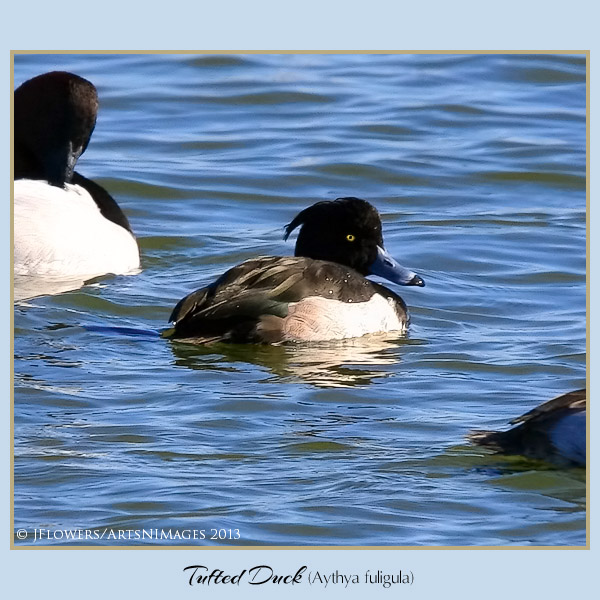
Union Mills Wetlands, Maryland

A casual search of the E-Bird database and maps brought this location to my attention just within the past week while I was looking at the observations by fellow birders for my area.   It has been listed as a “Birding Hotspot” for a long time, but I never though to click the marker and check the observations by others for the location.  The area is listed as the “Union Mills Wetlands” and is located just to the north of one of my favorite areas,  the Kowomu Trail,  just below the Pennsylvania state line near Union Mills Maryland.  It’s a mixture of planted trees, woodlands and a large freshwater marsh.  It is a protected area under the control of the Maryland Department of Natural Resources, bordered by a small dirt road that parallels its northern boundary with ample room to pull off to the side to set up a spotting scope or camera gear.

My initial exploration of the area alone Friday afternoon was rewarded by sightings of a flock of Eastern Bluebirds (7), Black-capped Chickadees (5), Tufted Titmouse (3), Hermit Thrush (1), ,Red Shouldered Hawk (1), Red-tailed Hawks (2) and a juvenile Coopers Hawk (pictured below) who posed for a few pictures without a care of my presence.  I  also observed include several species of sparrows.  This is going to be a wonderful place for photography in the very early morning and later afternoon light…

Immature Coopers Hawk, Union Mills Wetlands

The Freedom Township Grasslands,  Adams County, Pennsylvania

Eric Gerber made the commute from Middle River Maryland (a Baltimore suburb) bright and early Saturday morning to meet me at my home and then we would drive the short distance to Gettysburg and gather our friend Elmer Schweitzer for a day afield and the hunt for wintering raptors.  Elmer is blessed to live with  “Gal” friend Chris Arentz who owns a 300+ acre farm with prime birding habitat in the heart of the Freedom Township Grasslands just off Pumping Station Road and near the famous and historical Sachs covered bridge.

The Freedom Township Grasslands (open grasslands off of Pumping Station Road) is considered an “Important Bird Area” (IBA) by the Pennsylvania Audubon Society.  The area is a vast expanse of native grasslands, dotted by farms and a few homes all dedicated to the preservation of the wildlife and grassland habitat.  To the east of the area, and just west of the battlefield is the farm of the late president Dwight Eisenhower and  itself contains a large expanse of land and natural preservation forming the Eisenhower National Historic Site.

These grasslands are a favorite location for wintering birds and raptors with enough variety to keep a birder or an avid bird photographer happy throughout a cold winter’s day.  This area is the northernmost range of a number of southern birds, and the southernmost range of a number of northern species, and thus maintains long and diverse birding seasons that can offer wonderful surprises,  photography and observations.

Years back, the area held a decent breeding population of the Loggerhead Shrike and a few can still be found there today.  I had observed a single bird a few weeks back on a woodpile near and just west the Sachs Bridge.  Looking back, and after doing a little more research, I found that during 1992, the shrike was confirmed nesting in the Freedom Township Grasslands.  This nesting marked the first Pennsylvania confirmed nesting of this once extirpated species in 55 years.  The shrike was confirmed nesting in Adams County between 1992 and 1999 with approximately 47 birds fledged.  There has been no confirmed nesting of the shrike since 1999 however, individual birds have been observed.

Popular species for the area include the Upland Sandpiper, a listed Pennsylvania “Threatened species” and two listed Pennsylvania “Endangered Species”, the Dickcissel and Short-eared Owl (winter resident).  This area also includes the listed Pennsylvania “Endangered”  Least Shrew (a mammal) as well.  Other species found on the grasslands include  the Bobolink, Eastern Meadowlark, Grasshopper Sparrow, Savanna Sparrow and the Northern Harrier and several species of hawks.

This will mark the first year I have observed a Rough-legged hawk in this area sitting in an old tree, just east of the Arentz property.  American kestrels abound and can be found sitting on the tops of utility poles, lines or in the tress along any of the routes in the area.  A few years back, and during an invasion,  Chris Arentz had as many as 42 Short-eared owls perched in a confer just a few feet from her home.  They now are regular visitors, but not in such numbers, to a few of her trees and a woodpile behind her house.  On this trip we observed Red-shouldered, Red Tail and Coopers Hawks along with one solitary Sharpie.

A new addition to the area has been plantings of Ring-necked pheasants (pictured below) as a reintroduction project by a local farmer/landowner.  This bird was photographed on the Arentz property.

Ring-necked Pheasant, Freedom Township Grasslands

Marsh Creek and the Sachs Covered Bridge,  Adams County, Pennsylvania

Marsh Creek and the Sachs Covered Bridge are within themselves a wonderful habitat area on the eastern edge of the grasslands.  The woods to the north of Pumping Station Road along the creek and easily accessed from Scott Road, are home to variety of species including the Eastern Screech Owl and Barred Owl, both of which I have observed or heard in the near past.  Woodpeckers including the Hairy, Red-bellied and the Downy are prevalent here year round along with numerous species of songbirds especially in the spring and summer.  The creek holds waterfowl such as the Canada goose, Black Duck, Mallard and Wood Ducks.

To the south across Pumping Station road and towards the bridge along Waterworks road can be equally as productive for birds.  I have observed both the Barred Owl and the Great Horned Owl in this area too, along with a very friendly and photogenic Green Heron earlier in 2012.

Barred Owl, Marsh Creek, Pennsylvania

The Sachs Covered Bridge is in itself worth a visit, but look out for “Ghosties”!  According to the legend, three Confederate soldiers convicted of being spies were hanged from beams in the covered bridge and their bodies were discovered by Union soldiers patrolling the area.  Their spirits were said to haunt the bridge,  though other folks claimed they sometimes smelled General Lee smoking his pipe when they were standing on the bridge. The bridge is a popular destination for many of the Gettysburg area ghost tours and it’s not uncommon to visit around dusk or a little after to find a gathering of folks and their guide telling stories of “spooky” folklore!

This is the bridge that part of the Confederate Army of Northern Virginia used to begin their retreat to Virginia after the Battle of Gettysburg in July 1863.  In 1938, the Pennsylvania Highway Department determined the Sachs Covered Bridge to be the most historic covered bridge in the state.  It was closed to traffic in 1968 and listed in the National Register of Historic Places in 1980. On June 19, 1996,  flood waters swept the bridge from its abutments and carried it approximately 100 yards downstream. Adams County rehabilitated the bridge, supported its trusses with steel beams, and raised the elevation 3 feet…

Sachs Covered Bridge (Winter) Adams County, Pennsylvania

Red Rock Road,  Black Horse Tavern Road and Willoughby’s Run,   Adams County, Pennsylvania

Heading east back towards the Battlefield and Gettysburg,  you will come to the intersection of Black Horse Tavern road (left) and Red Rock road (right).  Both roads follow the small stream, Willoughby’s Run and present a wonderful wetland and upland habitat for many species.  A newly acquired parcel of land borders Willoughby’s Run, where Confederate General James Archer and 200 of his men were captured by General Solomon Meredith’s Iron Brigade.

Taking Black Horse Tavern road to the north will lead though farmlands, woodlands and small wetlands along the stream back towards Gettysburg and Route 116 (Fairfield Road).  You can also access Willoughby Run Road for further exploration and reach the same highway just a little east of the Black Horse Tavern intersection.  This is a popular route during late summer to find the many Cardinal flowers that bloom along the stream banks and a great place to observe and photograph hummingbirds.  Wading birds and waterfowl also inhabit the stream along with many songbirds.

To the south, Red Rock road follows the stream to its confluence with Marsh Creek.  There is an active Bald Eagle’s nest only a few hundred feet to the west of the road that presents wonderful opportunities for observation and photography.  Other raptors are present, especially during the winter months.  Pictured below is an American kestrel perched in an overhanging branch willing to pose for his photographer for a minute or two.  These birds are very skittish and I was quite amazed to have him give me a gander for an extended period of time.  I also observed a large flock of Eastern Bluebirds there just last week along with a stunning Red-tail Hawk.  I guess he wasn’t hungry.  Perhaps the Bald Eagle present kept the hawk at bay!

American Kestrel, Willoughby’s Run, Adams County, Pennsylvania

The Gettysburg National Battlefield and West Confederate Avenue,  Gettysburg, Pennsylvania

Gettysburg National Battlefield Grasslands

Gettysburg National Battlefield Grasslands

Where do I start???? There is just too much to cover about the Gettysburg National Battlefield, both historical and nature related in a simple blog article, but since we are on the subject of raptors and grasslands,  I will mention one or two of my favorite locations during this story.

West Confederate Avenue

West Confederate Avenue

From the north, and from the intersection with Route 116, West Confederate Avenue (See the map to the left) parallels one of the most open and expansive grasslands in the battlefield proper,  Seminary Ridge and Warfield Ridge.  A favorite of both birders and photographers seeking birds of prey, West Confederate Avenue provides a safe route of travel with ample pull offs and parking to just sit and observe this grassland habitat.  There are a few structures, old farms and dwellings within this area, but most of the area is wide open for the birds to patrol for a meal.

This grassland is also paralleled by the “very busy” Business Route 15 (Emmitsburg road) to the east.  There are a few places one can safely pull of the highway, but no where as numerous as that of West Confederate Avenue.  Popular spots are the Codori farm and a few others but use extreme caution along this stretch of roadway especially when parking, exiting or entering.

The West Confederate Avenue grasslands, especially Seminary Ridge, are a favorite of folks searching for Short-eared Owls who claim this area on a yearly basis.  As to this date, I have not observed any personally, but reports of the owls’ presence have been noted.  I have observed several northern harriers patrolling the area along with numerous hawk species.  I have also heard the trill of the Eastern Screech owl in the woods south of the Millerstown road intersection.  The woodlands also contain a nice population of Red-headed woodpeckers and northern flickers along with many songbird species.

Another great place to scope and observe the grasslands from an elevated location is from the Warfield Ridge observation tower.  The tower is just south of the Millerstown road intersection on the left.  It can get quite cold up in the tower , but it is hardly used during the winter months and worth the climb for you able-bodied, warm-blooded souls.

The highlight of this excursion was watching a Red-tail (pictured below)  force an American Kestrel to drop his prey, then retrieve it and fly off with the Kestrel in chase.  We also observed another Red-tail make a capture and then perch in a nearby tree to consume his meal. We observed a total of 5 different red-tails in the area.

Red-Tail Hawk with prey, Gettysburg National Battlefield

Wright Avenue and Howe Avenue,  Gettysburg National Battlefield,  Gettysburg, Pennsylvania

If you continue on West Confederate Avenue and cross Emmitsburg road (HWY 15), and then continue on South Confederate Avenue,  you will pass some very scenic landscapes,  a lovely farm to your left, and pass through wooded areas teaming with bird life especially in the area of Plum Creek.  Again there are plenty places for safely pulling over and observing and photographing nature along this route.  Keep a look out, and/or listen for Eastern Screech and Great horned owls early in the morning or late in the day at dusk.

Historic Farmstead, Gettysburg National Battlefield, Gettysburg, Pennsylvania

Continuing on South Confederate Avenue, and after you pass the trail head for Big Round Top,  take a right turn onto Wright Avenue and continue through the woods until you hit the open fields along Route 134 (Taneytown road).  Drive slowly and be observant of the large confers to your left as they may hold a perching and resting raptor scoping out the open field to the right for an easy meal.  We found a beautiful and uncommon Rough-legged Hawk sitting just inside the pines.  I just caught a glimpse of this majestic bird out of the corner of my eye and couldn’t stop and get the camera up in time before he flushed and flew across the field to perch in distant tree.

This same bird it seems had been perched across the highway on Howe Avenue and Eric managed to get a shot or two before it made another retreat.  Crossing Route 134 Wright Avenue turns into Howe Avenue, another favorite place of mine to photograph avian subjects.  To the left as you drive eastward on Howe Avenue is a large and thick stand of cedars and other young trees.  This area is of special interest to me because just a few evenings back,  I had stopped there for a moment and heard the solitary hoot of a Long-eared owl,  a very difficult bird to find due to their preference to be ”in the thick of things”.   Earlier in the day I had observed about 20 Cedar Waxwings frolicking in the outlying young trees of the stand of cedars. This location is ideal habitat for the Long-eared owl due to the cover for concealment and then access to the open field across the small road for hunting.  The Howe Avenue area receives very little traffic and is a nice place to spend a little time.

Shelter Belt Owling

Posted by Jim Flowers on December 16, 2012
Posted in: Birding, Birds. 2 Comments
Great Horned Owl (Bubo virginianus )

Great Horned Owl (Bubo virginianus )

One can hardly anticipate what one can discover on Maryland’s eastern shore.  Every exploration will yield a new adventure around every turn in the road, “especially the roads and trails off the beaten path, and through the marshes of this wonderful eco-system.”  Unlike my home on the north-east Texas Gulf coast, with its vast coastal and mostly tree-less prairies, the loblolly pine shelter-belts of the mid Atlantic coastal plains are rich and diverse with abundant life.  Numerous species of birds call the pines home throughout the four seasons.  One of my favorites is the Brown-headed Nuthatch.  Then not too far away and sometimes joining these pine stands are the hardwood forests and many brackish tributaries that flow life into the bays and rivers along with the grasses and phragmites that line their shorelines adding to the diversity of habitat for our wild friends.

Yesterday was to be a Owling expedition with perhaps a side trip to Cambridge and the waterfowl photographer’s “Wall of Shame” on Oakley Street where you can photograph the “ducks in a tub”.  The plan was to join fellow photographer and friend Larry Hitchens after his morning business appointment somewhere in the deep dark secrets of his beloved “Lower Slower Dorchester” County’s maze of little known wild spots.  Dorchester has become a second home for me as it is one of my favorite eastern shore haunts for birding and bird photography.  The Blackwater National Wildlife Refuge and the Fishing Bay Wildlife Management Area are just two of Dorchester’s wildlife gems presenting thousands of acres to explore and cherish for wonderful days afield.

The Blackwater refuge has a designated “Wildlife Drive” but as of today it’s far cry from the best location for wildlife observation or photography.  Like a lot of the refuges in our country,  the funding has fallen grace to more human comfort improvements instead of those aimed at the wildlife and property acquisition   But that’s a whole other discussion for another time.  Away from “drive” portion of the refuge are numerous and seldom visited areas that can be explored by trails and unimproved sandy roads, most of which are closed to vehicle traffic.  However, some are open and under good weather conditions can be easily driven, but with care.  My day was to be spent on one of these roads.  I will not reveal its location due to sworn secrecy and the threat of decapitation by Mr. Hitchens, but I will share my experiences and photographs.  It has been listed on a few birding reports but still is rarely traveled on any regular basis and one can spend an entire day here and not see another human being which was the case yesterday with the exception of one lone female birder.  She was only a passer-by and it was a very short time before she returned and made her exit.

I arrived at the roads entrance at nautical twilight and made the dark bumpy drive to its end near a creek within the vast open marsh hoping to park and watch for foraging short-eared owls and perhaps catch a glimpse of a Rough-legged Hawk that had been reported a few days back.  Right before dawn, a heavy fog settled in which made observations of any distance or scanning a horizon all but a futile attempt?  But it wasn’t all in vane as on one lonely scrubby tree the Rough-legged was found perched giving me a nice view through my binoculars for an easy ID.  I remained at this location for about an hour and caught the glimpse of a solitary short-ear cruising the marsh at a low-level searching for breakfast.  The view of the owl was short-lived as it disappeared into the fog.  I also observed two Northern Harriers doing the same.  The light was still way too low and obscured for any photography at this point.
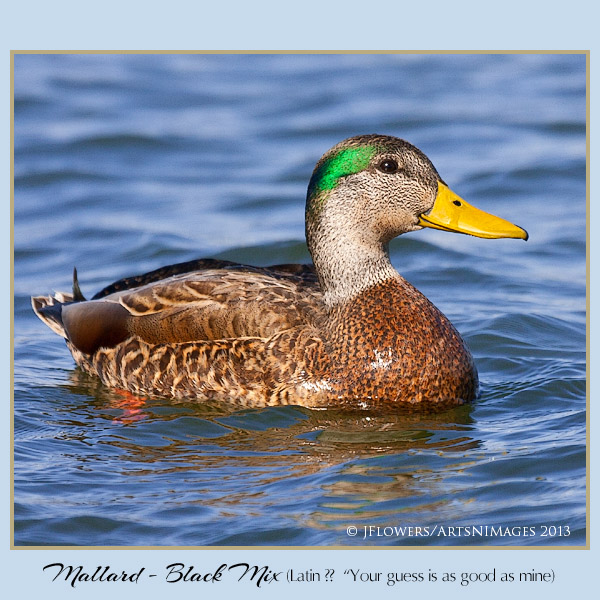

Foggy Morning Hooter

Foggy Morning Hooter

A little later the light improved but the fog blanket remained so I made my way back towards the first shelter-belt of pines hoping to perhaps attract a few small birds or two with a Screech Owl trill and maybe get lucky with a nuthatch.  This before departing into Cambridge for a short duck photography  session and the “meet up” with Larry.  As I found a location to stop, I heard the familiar hooting of a Great Horned Owl and it was very close and loud.  I also began to hear other hoots that were different to the one that was so close.  The light was still low but with a gentle bump of the ISO and an open lens the light would be sufficient for a few pictures.  The “Hoots” seemed to be that of an owl family and perhaps  last year’s offspring.  It was only a few short minutes before an adult Great Horned perched in a nearby tree, curious to observe his or her company sitting on the road watching.  He or she gave me a few shots before retreating further into the pines and then all I could see were shadows flying through the branches.  I observed up to three birds moving through the woods.

After another few minutes, I decide to go into Cambridge, visit the ducks and wait for Larry.  Arriving at Oakley I only found about a dozen Wigeon and Scaup, but all were well out on the river and no where close enough for photography.  I was also “corn less” so any food enticement was out of the question.   After visiting for only a minute or two I decided to phone Larry and ask him to meet me at the Blackwater refuge and closer to the good areas.  Larry arrived and I made mention of my owl find and we decided to return to the same location, set up our gear and spend the afternoon before going over to Fishing Bay and looking for the evening short-ears.  The fog had lifted and given way to lovely sunshine and blue skies upon returning to “the spot”….. Best of all, the light didn’t have the harshness of the typical late fall afternoon glow.  Our position was perfect too with the light being directly behind us and our targeted location just about 75 yards across a narrow grassy marsh with perfect openings and branches for the birds to perch in easy view.   “Now, if they were just still there…”

"Watchful Eyes"

“Watchful Eyes”

“And Yes They Were”,  as the hooting and frolicking was still under way by this bunch.  They would chase each other into the woods flying back and forth across from our location and sometimes directly overhead and low giving up ample opportunities for wonderful photographs.  They would then perch and peer at us for a few minutes, hoot and then resume their play.  We observed or heard up to five different birds of this species and all together within this selected area.  This is something I had never witnessed. I’m not sure if this was territorial sparring or just Mom, Pop and the kids out for a Saturday afternoon hullabaloo! Whatever the case,  it was certainly entertaining and presented a great opportunity for us along with a photographic blessing.

Larry is owl affection ado and the smile on his face was ever-present with a grin from ear to ear.  We were both totally over-taken by this and spent a good three hours there enjoying these birds that seemed endless in their play.  Larry was shooting his Canon EOS 1D Mark IV and his 600mm lens off a tripod and I was shooting my Canon 5D and the big heavy 400mm f2.8 with the 2x teleconverter attached giving 800mm off the roof of my vehicle on a bean bag.  It was a little awkward for me but something I had done many times before and the birds were truly obliging as if they wanted to make my day easy.

"Taking Flight"

“Taking Flight”

As we later departed, the birds were still present and their play continued.

We made our way to a favorite spot along the Fishing Bay marsh and waited for the Short-eared Owls to make an appearance.  There were four Bald Eagles present, all in  near adult colors, but I could tell they were youngsters, at least at heart as they sparred with in-flight play.  We had another full adult perched in a snag just behind us as we sat and waited.  Just at dusk one owl appeared, made a few passes and then disappeared into the horizon of the setting sun…  I managed one slightly out of focus silhouette image of the owl and that was all. But still what an amazing day it had been!  More to come I pray!

Jim Flowers

PS… God Bless the children and families of Sandy Hook Elementary

Trillium “A Passion for Learning”

Posted by Jim Flowers on December 8, 2012
Posted in: Blooms. 6 Comments
Snow Trillium (Trillium navale)

Snow Trillium (Trillium navale)

The year 2012 has been a fantastic adventure for “Birds and Blooms” on my part.  I practically dedicated my entire spring to photographing the flora of my area,  Texas and a few select areas of the southeast.

A few years back,  a fellow photographer and friend,  Mary Konchar from Cambridge Maryland,  introduced me to a brilliant 89-year-old “youngster” by the name of Elmer Schweitzer.  Elmer and I share a love for birds,  but his passion for photographing wildflowers,  especially wild orchids and his love for,  knowledge of and dedication to the conservation of the species is overwhelming.  Elmer and I hit it off right away with our old school attitudes towards the craft of photography and our love for the natural world. I knew very little about plants and blooms,  but I’ve had a fascination for many years.  And now “picking” Elmer’s brain has been and continues to be an adventure.  I do my best to reciprocate for Elmer’s sharing of his friendship,  knowledge and direction by helping him find and photograph birds as well as a little tutelage of digital post processing, but my attempts only underscore his generosity!  Elmer’s personality is a “Hoot” as well!  Everyday spent with this gentle soul ends with a smile and a yearning anticipation for the next outing.

Since joining the Wildlife South staff as a writer, photographer, and photographic forums moderator,  my curiosity for flora has “blossomed” (pardon the pun) and I developed an interest in the genus of Trillium which includes 40 to 50 species of spring ephemeral perennials.  A recent Wildlife South article, “Trillium in the South” by Will Stuart enhanced my interest in this species.   I was fascinated by the names Wake-robin, tri flower and birthroot and especially any medicinal uses by Native Americans as so many of the plant species have to offer.  Folklore suggests that Trillium was used to facilitate childbirth and to treat other female problems by the women of many Native American tribes.  Trillium root was considered to be a sacred female herb and they only spoke of it to their medicine women.

I had mentioned the genus and my interest to Elmer on occasion and he responded with excitement on sharing his knowledge of  “secret spots”  and well-known locations to find the species.  One of which was the smallest, earliest and rarest of the family, the Snow Trillium.  Our adventure and quest for the Snow Trillium began with an early morning rise and a long trip west on the Pennsylvania turnpike towards Pittsburgh and New Stanton.  I will not divulge the exact location as it is not mine to share. However, this species can be found in several locations in western Pennsylvania, with a few being well-known and popular.  Ours were located on a hillside along an old railroad grade beside a creek. Trillium navale or Snow Trillium are considered rare and threatened and can only found in the counties of Beaver, Allegheny, Westmoreland, Washington, Indiana and Armstrong in Pennsylvania as of today.  It is one of the first wildflowers to emerge during March and April and as the name suggests, the blooms can be found with snow still on the ground.

Snow Trillium (Trillium navale)

Snow Trillium (Trillium navale)

We were very pleased to “hit it just right” and find a nice collection of plants and blooms at this location although some had been stomped down by less knowledgeable human sightseers.  Elmer gets quite “red-faced” with disgust when he finds a lack of consideration or appreciation for his beloved wildflowers.  He is always very passionate with me about “treading lightly” and paying close attention to where I step.  I respect and admire that!  I can picture a few times in the past where I might have destroyed a few plants by accident for my lack of cautious footing.  We spent a good two hours here photographing the blooms and enjoying their presence.  We concluded our day with a side trip to Ohiopyle State Park and the falls of the Youghiogheny River.

My next exploration for the Trillium species would be a pleasant addition to the end to our annual spring pilgrimage home to the Texas Gulf coast with a little side trip along the Blue Ridge Parkway in North Carolina on the return to Pennsylvania.  We spent the night in Pigeon Forge Tennessee and with an early morning departure, began the trek along the drive in the Great Smoky Mountains National Park and then continued northward towards Asheville North Carolina.  The drive was lovely with very little traffic so pulling off for a few pictures was an ease.  One of these days I would like to do the entire length from Virginia to Tennessee or vice versa with ample time to thoroughly enjoy this scenic route.  There is so much to see and do.

Besides looking for Trillium,  I was fascinated by the Bluets, Houstonia serpyllifolia Michx-Thymeleaf bluet (Quaker Ladies, Blue-eyed Babies) blooming among the drips of the rocky outcroppings along the drive.  The species Houstonia is named for William Houston, a botanist in the early 1700’s who is also known as the man who introduced buddleia into cultivation.  These tiny gems were fun to observe and photograph. (Pictured below)

Thymeleaf Bluet (Houstonia serpyllifolia Michx)

Thymeleaf Bluet (Houstonia serpyllifolia Michx)

Another interesting find was a species of Indian Paintbrush, castilleja coccinea that closely resembles our Texas species, Castilleja indivisa with the same name.  The Indian Paintbrush and the Texas Bluebonnet, Lupinus texensis are the jewels of the Texas spring wildflower season.  There were other notable species but the list is too lengthy to give all their due as Trillium was my primary quest.

As we descended in elevation, we began to find the first and only Trillium species visible along this portion of the drive, roadside within the ravines of the hardwood forested sections, Trillium grandiflorum with common names including Large-flower wakerobin, Large-flowered trillium and White trillium.  There were numerous sightings along the drive but not many locations were easily accessible for safely pulling off to the side of the road for photography.  But I did manage to find a couple of spots for a nice picture or two. (below)  We enjoyed the rest of the drive and exited just south of Roanoke Virginia to continue our trip home on the much faster interstate highways.

Large-flowered trillium (Trillium grandiflorum)

Large-flowered trillium (Trillium grandiflorum)

Returning home and back to the weekly grind of work brought more weekend outings with Elmer and continued Trillium seeking adventures along with other wildflowers from our area.

Elmer had mentioned a location in Lancaster County that I had driven by many times without ever a thought of stopping for a visit,  more less knowing that it was a Trillium hotspot.  It’s called the Shenk’s Ferry Wildflower Preserve owned by the PPL Energy Corporation along the Susquehanna River.  I will include a  link for the preserve at the bottom of this article.

The preserve is located within a rich ravine habitat housing a small tributary flowing into the Susquehanna River.  Following Shenk’s Ferry road from River road you will descend into a valley and enter a small bumpy dirt affair leading through a dark old railroad tunnel and on to the trail head and parking areas.  You can find brochures for the area at the trail head.  The tempered climate due to the steepness and depth of the ravine creates a diverse and gentle eco-system and environment allowing the may species of wildflowers to flourish that grow there.  The species of Trillium found at the preserve include Trillium Erectum v. album,  Trillium flexipes or Trillium grandiflorum.  (Pictured below)

Wakerobin (Trillium Erectum v. album)

Wakerobin (Trillium Erectum v. album)

Drooping Wakerobin (Trillium flexipes)

Drooping Wakerobin (Trillium flexipes)

Another predominant species is the Virginia Bluebell, (Mertensia Virgininica).  Visiting the preserve at just the right time can present one with a swath of white and blue color lining the ravine with a visual splendor.  Other wildflowers found within the preserve include the round-lobed Hepatica (Hepatica americana) , Eastern Red Columbine (Aquilegia canadensis),  Dutchman’s breeches (Dicentra cucullaria), Squirrel Corn (Dicentra canadensis), Mayapple (Podophyllum peltatum), Trout lily  (Erythronium americanum), the Spring Beauty (Claytonia virginica,), Bloodroot (Sanguinaria canadensis), Early saxifrage (Saxifraga virginiensis) and an invasive exotic, Ranunculus ficaria, Lesser celandine.

Elmer and I spent several hours at the preserve exploring and photographing the Trillium and a few of the other species.  I was like a child in a candy store and forever badgering Elmer’s expertise.  I’m sure he felt like a walking Encyclopedia.  We ended this outing at the Lancaster County Park and a lovely garden known as the “Garden of Five Senses”.  The garden is dazzling with color throughout the year, and during spring and summer, its flowers provide a bouquet of scents.   The garden sits on a hill overlooking the Conestoga River and is open to the public year round.

Elmer wanted to introduce me to another species of Trillium as well as some variations to one we had already photographed.  This was “home turf” to Elmer as his original residence was in Lancaster city.

Elmer had to use a stick to part the surrounding plants to expose the new species, Toadshade trillium (Trillium sessile).  The variation of the previous species at Shenk’s Ferry was the red version of the Wakerobin (Trillium Erectum).  Both were lovely and are pictured below.  What a wonderful and educational day it had been.

Toadshade Trillium (Trillium sessile)

Toadshade Trillium (Trillium sessile)

Wakerobin red (Trillium Erectum)

Wakerobin red (Trillium Erectum)

My final lesson on the Trillium and the discovery of another species to add to my list was during a trip to photograph the Showy Orchis (Galearis spectabilis), Pink Lady’s Slipper Orchid (Cypripedium acaule) and the Yellow Lady’s-Slipper Orchid (Cypripedium calceolus) in upper Lancaster County Pennsylvania and the hills near the Middle Creek Wildlife Management Area.  During our hike to Elmer’s secret treasure trove of orchids he pointed out the Nodding Wakerobin, Trillium cernuum.  It was tiny with the bloom under its large leaves.  I would have passed it by without hesitation and hardly a notice.  It is pictured below.

Nodding Wakerobin (Trillium cernuum)

Nodding Wakerobin (Trillium cernuum)

For a new Trillium species, we hope to travel north and eastward this coming spring to photograph the Painted Trillium, Trillium undulatum, the most colorful and the loveliest of the genus.  Elmer states “He knows where to find them” and I’m excited!

My knowledge of wildflowers is forever growing and I can successfully ID many species through a network of reference materials I have put together over the past months.  But it’s a “heck of a lot more fun” to pick the brain of my friend and enjoy his dry wit at the same time! I hope you enjoyed our Trillium adventures.

Jim Flowers

For more information on the Shenk’s Ferry Wildflower Preserve…. Go Here!

Posts navigation

← Older Entries
Newer Entries →
  • Categories

    • Audio Visual
    • Birding
    • Birds
    • Blooms
    • Coastal Birds
    • North American Raptors
    • Raptors
    • Travel
    • Uncategorized
    • Woodland Warblers
  • Clapper Rail

  • Recent Posts

    • “Wood Warblers” of the Mid-Atlantic States November 1, 2021
    • Butterflies and Blooms November 1, 2021
    • “To Be An Owl” August 29, 2021
    • “Simply Solitary” and friends August 20, 2021
    • Black-throated Blues April 14, 2020
    • Woodland Orchids … an “endeavor of passion” April 3, 2020
    • A Celebration of Our American Bald Eagle March 28, 2020
    • “Water Walkers” A Collection of Favorites from our Coastal Plains October 22, 2019
    • Just Passing Through,….. the Palm Warbler October 15, 2019
    • “Pine Barren Blues”, Gentiana autumnalis, The Pine Barren Gentian September 24, 2019
    • The Melody of Warbler Road – the Hooded Warbler August 29, 2019
    • “Baby Blues”,,,,, 4 to 6 Inches of Colorful Splendor! August 24, 2019
    • Springtime Along the Texas and Louisiana Gulf Coast (Video) May 21, 2019
    • In search of “Maggie May” … Woodland Warblers 3 February 16, 2018
    • “Fish Hawk” the Osprey … January 9, 2018
    • Bog Life November 10, 2017
    • Prairie Song … Woodland Warblers 2 March 14, 2016
    • Life In Black & White … February 26, 2016
    • The Short-eared Owl – Wetlands, Grasslands and Raptors Part 3 February 5, 2016
    • “Wild Goose Chase”…The Quest for the Arctic Traveler November 23, 2014
    • “Fall Migration” a time for discovery! August 23, 2014
    • “DUCKS IN A TUB” … Say it with corn and they will come!!! November 23, 2013
    • “The Bitterns” Hide and Seek in America’s Wetlands July 3, 2013
    • “Bloodroot” … War Paint and the Medicine Man June 26, 2013
    • “Trillium A Plenty” Shenk’s Ferry Wildflower Preserve June 7, 2013
  • Archives

    • November 2021 (2)
    • August 2021 (2)
    • April 2020 (2)
    • March 2020 (1)
    • October 2019 (2)
    • September 2019 (1)
    • August 2019 (2)
    • May 2019 (1)
    • February 2018 (1)
    • January 2018 (1)
    • November 2017 (1)
    • March 2016 (1)
    • February 2016 (2)
    • November 2014 (1)
    • August 2014 (1)
    • November 2013 (1)
    • July 2013 (1)
    • June 2013 (2)
    • February 2013 (1)
    • January 2013 (2)
    • December 2012 (3)
    • November 2012 (1)
  • Links and Favorites

    My Website
    Arts N Images

    Birding

    Birding Organizations

    National Audubon Society
    The Cornell Lab of Ornithology
    American Birding Association
    E-Bird
    Maryland Ornithological Society
    Pennsylvania Society for Ornithology
    Texas Ornithological Society
    Boreal Songbird Initiative

    Bird Sounds

    xeno-canto

    Bird Identification and Guides

    All About Birds-Cornell
    Guide to North American Birds
    David Sibley Guides
    WhatBird.com

    Botany and Wildflowers
    Lady Bird Johnson Wildflower Center
    USDA Plants Database
    Wildflowers of the United States
    North American Orchid Conservation Center
    Carnivorous Plant Resource Center

  • January 2026
    M T W T F S S
     1234
    567891011
    12131415161718
    19202122232425
    262728293031  
    « Nov    
  • My You Tube Channel

  • Enter your email address to follow this blog and receive notifications of new posts by email.

  • NOTE

    My "Birds and Blooms" Blog is a personal journal (birdsandblooms.me) and is NO way associated with the wonderful Birds And Blooms Magazine, Blog or Website (birdsandblomms.com)
Blog at WordPress.com.
Birds and Blooms
Blog at WordPress.com.
  • Subscribe Subscribed
    • Birds and Blooms
    • Join 148 other subscribers
    • Already have a WordPress.com account? Log in now.
    • Birds and Blooms
    • Subscribe Subscribed
    • Sign up
    • Log in
    • Report this content
    • View site in Reader
    • Manage subscriptions
    • Collapse this bar